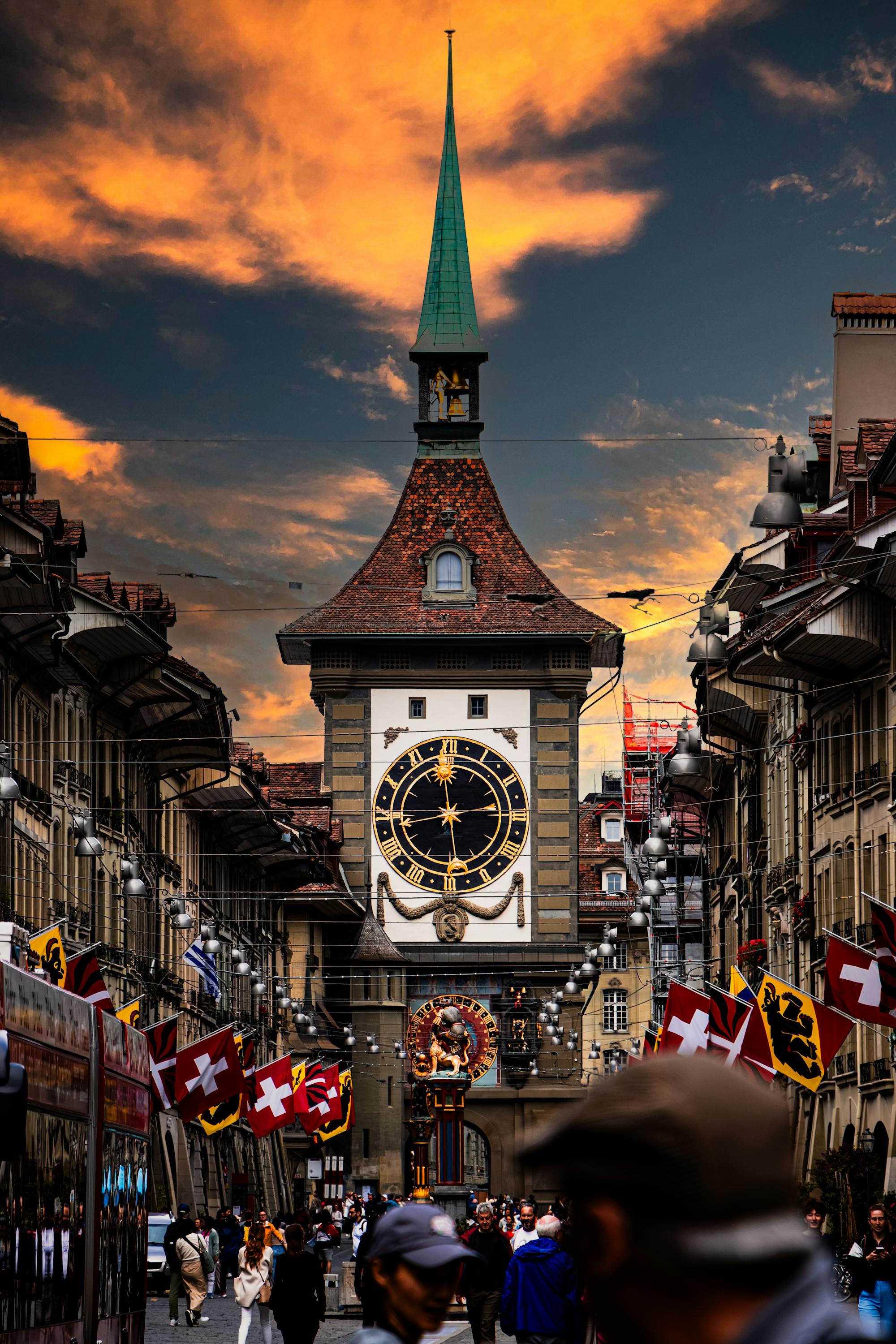
Bern's old town is one of Europe's best-preserved medieval cities and an UNESCO World Heritage Site — six kilometres of arcaded sandstone walkways known as Lauben shelter pedestrians from rain and sun in a covered promenade that has been in continuous use since the 13th century. The Zytglogge astronomical clock, striking since 1530, draws the expected crowds; the Rose Garden above the Nydegg district offers the finest panorama of the ochre rooftops and the Aare river's luminous turquoise bend below. The Zentrum Paul Klee, designed by Renzo Piano, holds the world's largest collection of the Bern-born painter's work in a building of extraordinary sculptural elegance. Albert Einstein lived and developed the theory of relativity here — his apartment on Kramgasse 49 is a small, moving museum.
- Suggested duration: 2–3 days
- Best time to visit: April to October for outdoor exploration; the Christmas market around the Münster is among Switzerland's finest.
Bern operates at a distinctly Swiss frequency — precise, cultured, unhurried, and possessed of a quiet confidence in its own worth that makes it entirely resistant to the need to impress. It is exactly the kind of city that rewards those who are not in a hurry, and punishes those who are. Give it two days minimum; three is better.
The Lauben: Six Kilometres of Covered Arcades
Bern's defining architectural feature is its system of covered walkways — the Lauben — that run beneath the buildings on both sides of the old town's main streets. Built in sandstone from the 12th century onwards, they form one of the longest covered shopping promenades in the world and are the reason Bernese street life continues at full pace regardless of weather. Beneath these arcades, the city's most interesting independent shops occupy the ground floors of buildings that have housed commerce in the same spot for seven or eight centuries.
The Einstein Connection
Bern's most unlikely attraction is the apartment at Kramgasse 49 where a 26-year-old Albert Einstein lived from 1903 to 1905, working by day as a patent office clerk and in the evenings producing the papers that would define 20th-century physics. The apartment is preserved to reflect the period and includes an engaging exhibition on the annus mirabilis of 1905, when Einstein published his four most revolutionary papers — including the special theory of relativity and the paper on the photoelectric effect that would win him the Nobel Prize. It is a small museum but a genuinely moving one, made more so by the contrast between the modest domestic setting and the scale of what was conceived here.
The Bernese Oberland: Mountains on the Doorstep
Bern's greatest asset for the traveller with more than two days is its proximity to the Bernese Oberland — the high Alpine landscape of the Eiger, Mönch, and Jungfrau that is one of Europe's most dramatic mountain settings. Interlaken is 50 minutes by train from Bern, and from there the extraordinary rack railway climbs to the Jungfraujoch (3,454m) — the highest railway station in Europe, with views over the Aletsch Glacier that are genuinely among the finest mountain panoramas on the continent. Grindelwald, Lauterbrunnen, and the car-free village of Wengen all make excellent bases for Alpine hiking in summer or skiing in winter.