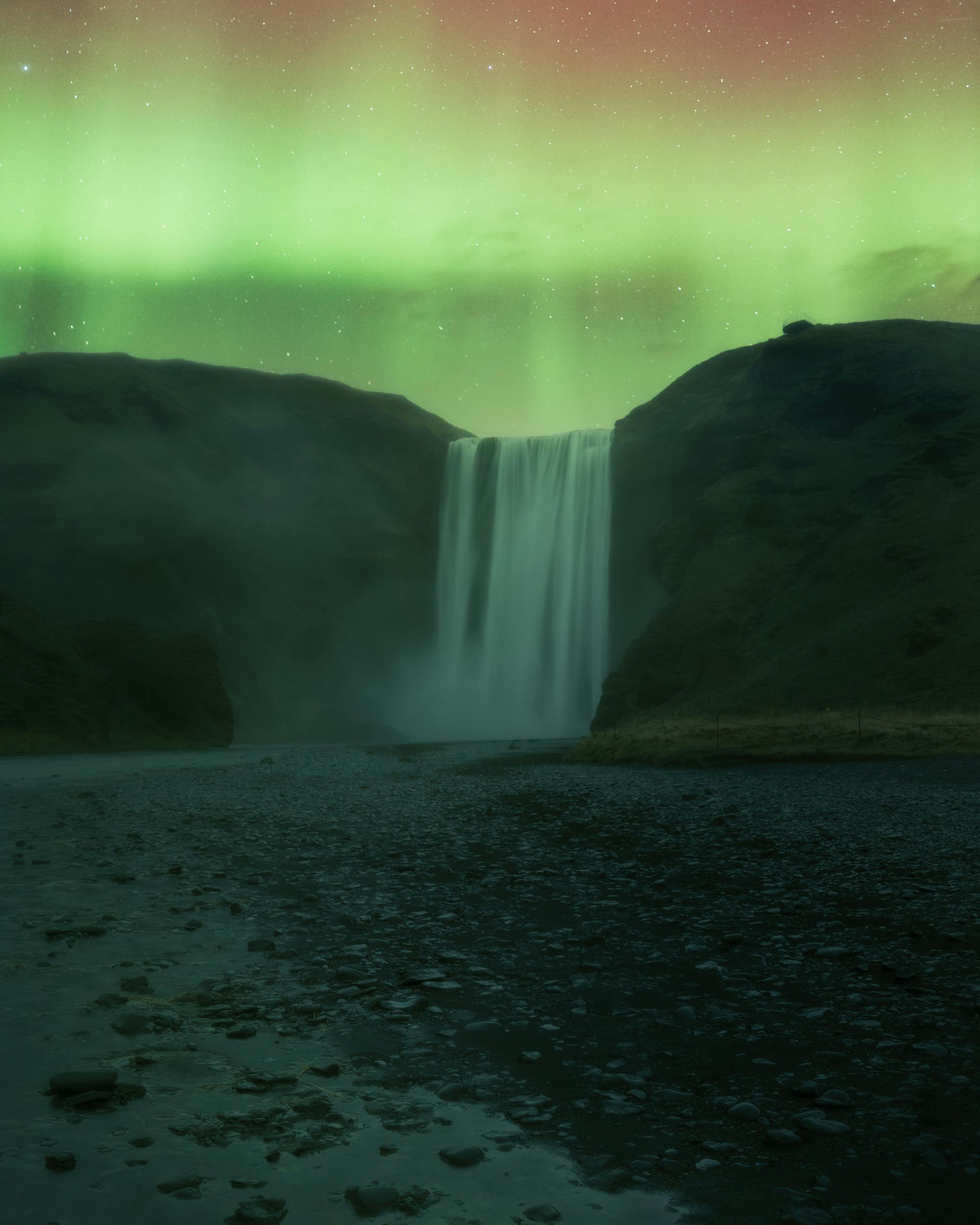
Aurora-lit skies, geothermal pools, and glaciers that recall the planet's primordial origins.
- Suggested duration: 7–10 days
- Best time to visit: Sep – Mar
- Budget: $$$
Few places on Earth force you to reckon with nature the way Iceland does — where volcanoes and glaciers coexist within a short drive, and the sky turns green on a clear winter night.
Iceland sits on the Mid-Atlantic Ridge, making it one of the most geologically active places on the planet. That geological energy is exactly what draws travelers here: boiling geysers, steaming lava fields, black sand beaches sculpted by the Atlantic, and waterfalls that appear out of nowhere. Yet Iceland is also remarkably accessible — Reykjavik is a compact, walkable capital with world-class restaurants and a nightlife scene that punches far above the country's population of 370,000.
Planning your route
The classic itinerary is the Ring Road (Route 1), a 1,332 km highway that loops around the entire island. Most visitors drive it in 7–10 days, stopping at the Golden Circle (Geysir, Gullfoss, Þingvellir), Jökulsárlón glacier lagoon, Snæfellsnes Peninsula, and the dramatic Westfjords. Renting a 4×4 is strongly recommended — many of the most spectacular detours require it.
What to expect by season
Summer (June–August) brings the midnight sun — 24 hours of daylight that lets you hike until 11 pm. Temperatures hover around 10–15°C. Winter (November–February) is cold and dark but offers the best chance of seeing the Northern Lights, provided you stay away from Reykjavik's light pollution. Shoulder seasons (May and September) offer a balance of decent weather, smaller crowds, and reasonable prices.
Budget breakdown
Iceland is not cheap. Budget travelers can get by on around $120–$150 per day by camping, cooking, and using guesthouses. Mid-range hotel stays, a car rental, and restaurant meals add up to $250–$350 per day. Luxury lodges — many with private geothermal pools — can push that to $500+ per day. The biggest costs are accommodation, car rental, and fuel, as gas prices are significantly higher than in the US or UK.
Top experiences not to miss
- Blue Lagoon — Iceland's most famous geothermal spa, best booked months in advance for peak season dates.
- Glacier hiking on Vatnajökull — Europe's largest glacier, accessible via guided tours from the Ring Road.
- Whale watching in Húsavík — the whale watching capital of Europe, with humpback and minke whales frequent in summer.
- Landmannalaugar — a highland destination with rainbow-colored rhyolite mountains and natural hot springs, accessible July–September only.
- Puffin spotting — Iceland is home to roughly 60% of the world's Atlantic puffin population; the Westman Islands are the prime location.
Planning your Iceland trip with AI
Iceland's rapidly changing road conditions, seasonal access restrictions, and the unpredictability of Northern Lights make it one of the most planning-intensive destinations in Europe. An AI travel assistant can build a day-by-day Ring Road itinerary around your specific travel dates, factor in which routes are only accessible in summer, compare campervan versus hotel options given your group size and budget, and flag which experiences require advance booking months ahead. Ask it to build in flexibility buffers — weather in Iceland can close highland roads with very little notice.