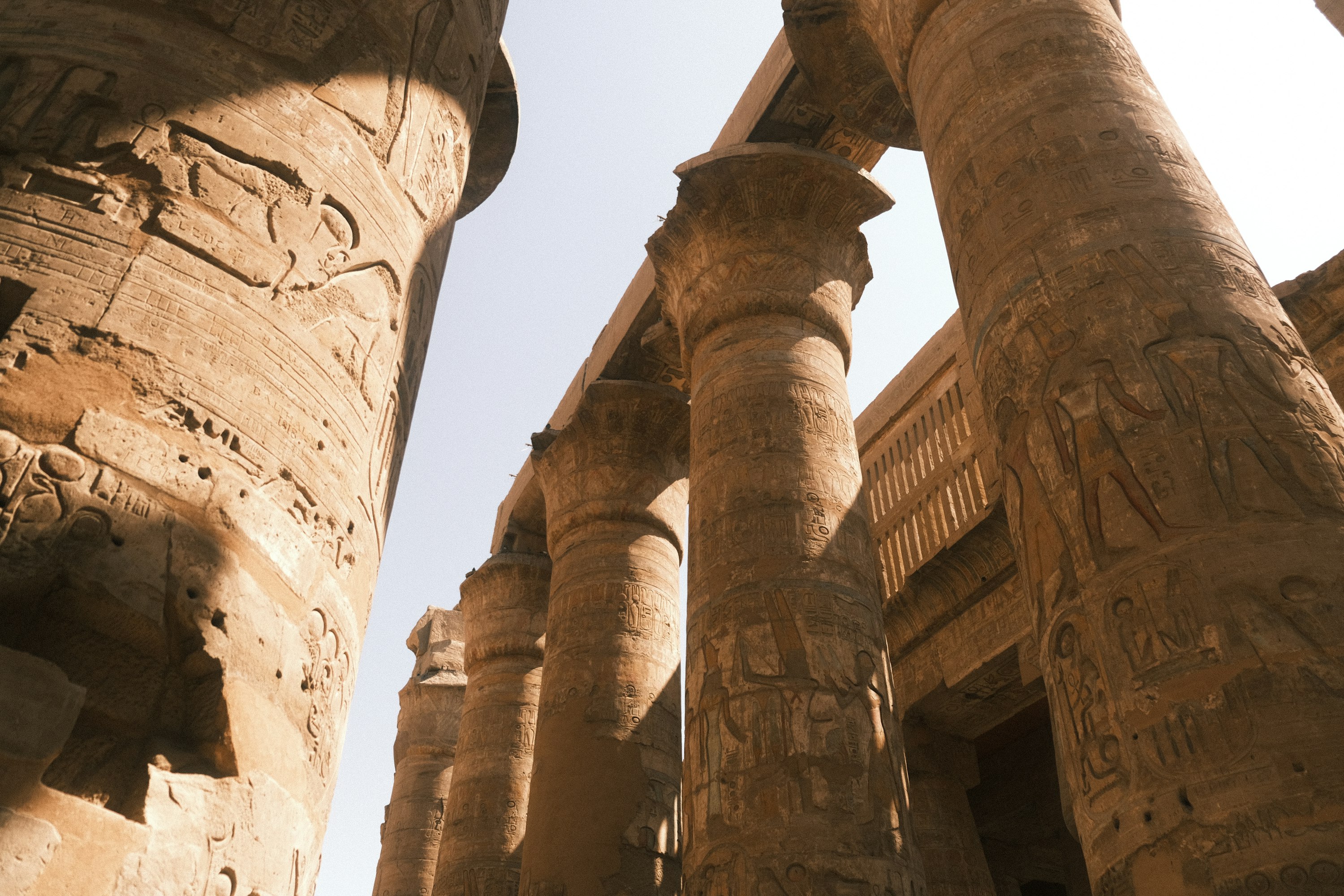
Luxor sits on the banks of the Nile in Upper Egypt, a small city built directly on top of ancient Thebes — once the most powerful city in the world. Two riverbanks, thousands of years of history: the east bank holds colossal temples still standing after 3,000 years, while the west bank is honeycombed with royal tombs including the legendary Valley of the Kings. Nowhere else on Earth offers such concentration of monumental ancient heritage.
- Suggested duration: 3–5 days
- Best time to visit: October to March
- Budget: Budget to mid-range: $40–$90/day
Standing in the hypostyle hall of Karnak Temple — surrounded by 134 towering sandstone columns, each carved with hieroglyphs and painted reliefs — is one of the most humbling experiences travel can offer. Luxor is that kind of place: a city where the ancient world is not behind glass but all around you, breathing and magnificent, still speaking across three millennia.
Top Experiences & Highlights
Luxor's sights are so extraordinary that it can feel overwhelming to plan a visit. The key is to split your time between the two banks of the Nile and take things at a measured pace — this is not a city to rush.
- Explore the Karnak Temple Complex — the largest religious site ever built, developed over 2,000 years by successive pharaohs and utterly breathtaking at the sound-and-light show after dark
- Descend into the Valley of the Kings on the west bank, where more than 60 royal tombs are carved deep into the limestone cliffs
- Walk the Avenue of Sphinxes, a recently restored 3km processional road connecting Karnak and Luxor Temple
- Rise before dawn for a hot-air balloon ride over the West Bank as the sun rises over the Theban hills — one of Africa's most iconic travel experiences
Culture & History
For nearly 500 years, Luxor — then called Thebes — was the capital of the New Kingdom, the height of pharaonic power. Its temples were not just places of worship but expressions of divine kingship, political propaganda, and cosmic order. Even after the capital moved, Luxor remained a sacred city and a place of pilgrimage.
- Visit the tomb of Tutankhamun in the Valley of the Kings, still the most famous royal burial ever discovered
- Cross to the west bank to see the Mortuary Temple of Queen Hatshepsut, one of ancient Egypt's most powerful rulers, terraced dramatically against the cliffs
- The Luxor Museum offers a beautifully curated collection of New Kingdom statuary — far less crowded than Cairo's Egyptian Museum
- See the Colossi of Memnon at dawn, two 18-metre seated statues that have guarded the floodplain for 3,400 years
Food & Cuisine
Luxor's food scene is simpler than Cairo's but deeply satisfying. The city has a growing collection of rooftop restaurants with Nile views, alongside local kushari spots and fresh-from-the-river fish grills. The corniche in the evening is the social heart of the city.
- Grilled Nile perch or tilapia at a corniche restaurant with sunset views over the river is a Luxor ritual
- Pick up warm aish baladi (flatbread) and fuul from a neighbourhood bakery for an authentic Egyptian breakfast
- Try local sugarcane juice pressed fresh at streetside carts — refreshing in the dry Upper Egyptian heat
- Several guesthouses and heritage hotels offer rooftop dinners with temple-lit views that are well worth the splurge
Best Neighbourhoods & Areas
Luxor is a compact city by Egyptian standards, and most visitors base themselves near the east bank corniche or in the quieter west bank villages. Each offers a very different experience.
- East Bank / Luxor Town Centre — home to Luxor Temple, the main hotels, and the corniche restaurants; convenient and lively
- West Bank — staying in villages like Al-Gurna puts you steps from the Valley of the Kings and offers a more rural, local experience
- Karnak area — hotels near the Karnak Temple allow for early-morning visits before the tour groups arrive
Practical Tips
Luxor's summer heat (June–August) regularly exceeds 40°C — visiting in this period is not recommended. The cooler months from October through March are ideal, with mild days and cool evenings perfect for exploring.
- Purchase a combined Valley of the Kings ticket in advance; individual tomb add-ons (like Nefertari or Seti I) cost extra and have limited daily visitors
- Hire a private driver for the west bank — the distances between sites make cycling or taxis more practical than walking
- Visit Karnak at the sound-and-light show in the evening for an atmospheric and crowd-free experience
- Most tombs prohibit photography — respect this rule and simply be present in one of the world's greatest archaeological spaces