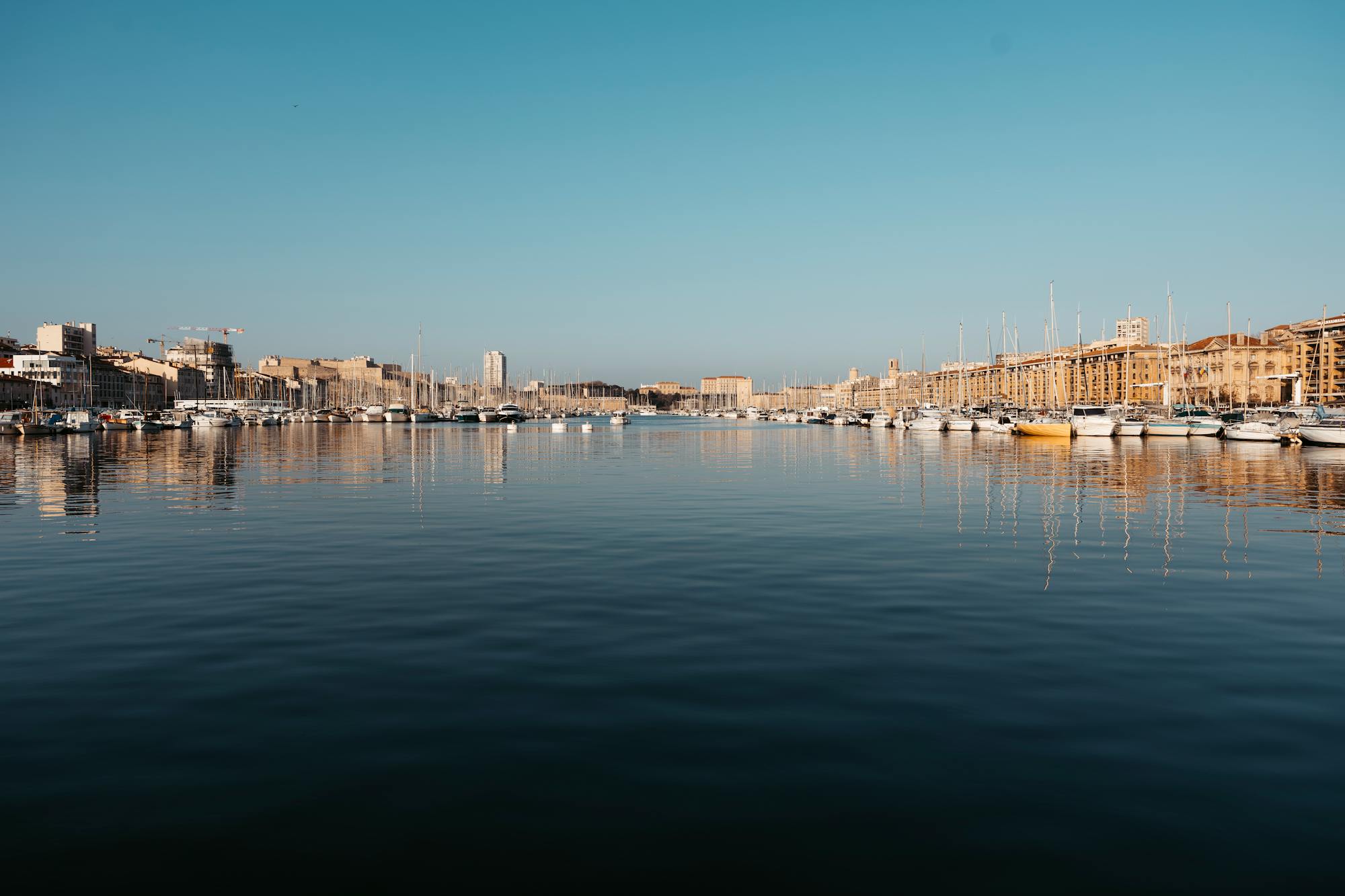
Marseille is the Mediterranean's most visceral city — 2,600 years of Phoenician, Greek, Roman and Arab influence layered into a port that still smells of saffron and the sea. The Vieux-Port is its beating heart, where fishing boats bob beside the MuCEM museum's extraordinary lace-clad concrete, and the hilltop Basilique Notre-Dame de la Garde watches over everything. For luxury travellers, the Calanques national park — turquoise inlets between white limestone cliffs accessible by boat — is one of France's most spectacular natural experiences. Dine on authentic bouillabaisse at La Mère Besson or the Michelin-starred Le Petit Nice, perched on the rocks above the sea.
- Suggested duration: 3–4 days
- Best time to visit: May to June and September to October offer warm weather, clear seas and smaller crowds. July and August are vibrant but very busy.
Marseille resists easy summary. It is simultaneously France's most challenging and most rewarding large city — a place that demands engagement on its own terms rather than according to any conventional tourist agenda. Those who do engage find a city of extraordinary depth, beauty, and vitality.
The Calanques: Nature at its Most Dramatic
The Calanques National Park, accessible on foot or by boat directly from Marseille's southern suburbs, is one of France's most spectacular natural environments — a 20-kilometre stretch of white limestone cliffs plunging into waters of an almost improbable turquoise clarity. The fjord-like inlets (calanques) of En-Vau, Port-Miou, and Morgiou are among the most beautiful natural features on the French Mediterranean coast, and the combination of dramatic cliff scenery, clear water, and wild garrigue vegetation is unlike anything else accessible from a major European city. Boat trips from the Vieux-Port explore the coast in comfort; hikers can access several calanques on foot via the coastal GR98 trail, though access is restricted in summer due to fire risk.
Le Cours Julien: Marseille's Creative Quarter
The Cours Julien neighbourhood, rising uphill from the Canebière, is Marseille at its most contemporary: a sloping square surrounded by outdoor café terraces, street art murals covering entire building facades, independent record shops, vintage clothing stores, and natural wine bars. It is the city's most genuinely bohemian quarter — frequented by artists, musicians, and the creative community that has made Marseille an increasingly significant cultural centre. The surrounding streets of Noailles and Belsunce, the city's North African heart, offer a sensory immersion into Marseille's multicultural reality that is entirely different in character but equally compelling.
Islands and the Archipelago of Frioul
Immediately offshore from the Vieux-Port, the Archipelago of Frioul comprises four rocky islands — Ratonneau, Pomègues, If, and Tiboulen — accessible by regular ferry service. The Château d'If on Île d'If, built in 1524 as a coastal defence and later converted to a prison, is the real-world setting for Alexandre Dumas's Count of Monte Cristo; its cells, fortifications, and the extraordinary view back toward Marseille are memorable. The islands of Ratonneau and Pomègues, connected by a harbour wall, have several excellent swimming coves and a small yacht marina.