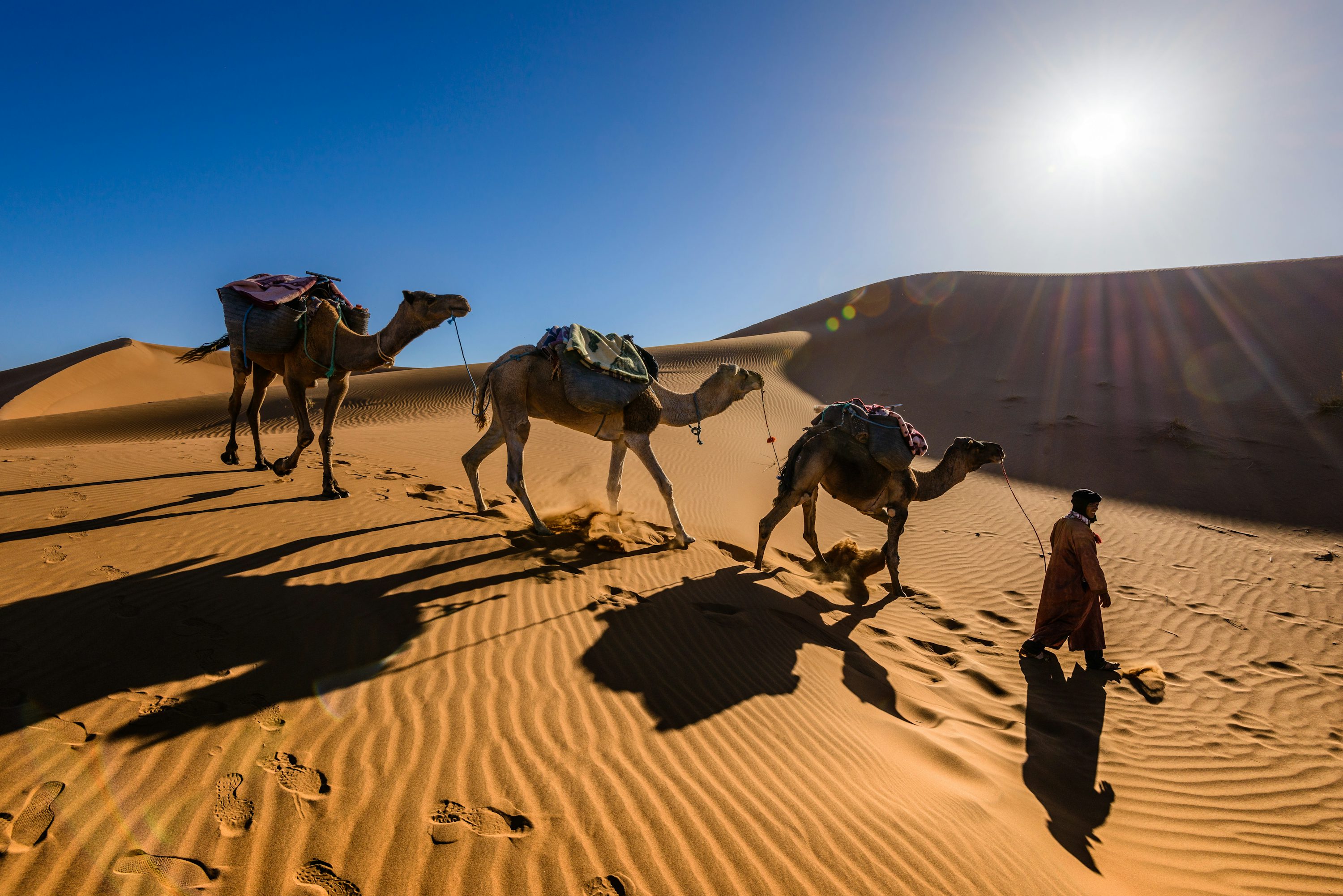
Morocco is a land of extraordinary contrasts — rose-pink desert dunes rolling into snow-capped mountains, labyrinthine medieval cities beside modern boulevards, and a cuisine that fuses Berber, Arab, and Andalusian traditions into something entirely its own. Few destinations on earth pack so much colour, history, and sensory intensity into a single journey.
- Suggested duration: 10–14 days
- Best time to visit: March to May and September to November
- Budget: Mid-range: $100–$180/day
Morocco rewards the curious traveller at every turn. Whether you're sipping mint tea in a riad courtyard in Marrakech, watching the sun melt into the Sahara from a dune-top, or bargaining cheerfully in a centuries-old souk, Morocco delivers experiences that linger long after you've returned home. It is, simply put, one of the world's most captivating destinations.
Top Experiences & Highlights
From the imperial cities to the deep desert, Morocco's highlights are as varied as its landscapes. The country rewards those who venture beyond the obvious — though the obvious is pretty spectacular too.
- Sleep under the Sahara stars at an Erg Chebbi camp near Merzouga, waking to silence and gold-lit dunes
- Explore the medinas of Fes, Marrakech, and Chefchaouen, each with its own character and pace
- Hike the High Atlas to Toubkal, North Africa's highest peak, with Berber villages as your waypoints
- Drive the Draa Valley through palmeries and kasbahs on the road south to the desert
Culture & History
Morocco's layered history spans Berber kingdoms, Roman outposts, Arab dynasties, Andalusian refugees, and French and Spanish colonial eras. Each epoch has left its mark — in the architecture, the music, the language, and the food.
- The Roman ruins of Volubilis near Meknès are among the best-preserved in Africa, with sweeping mosaics still intact
- The Ben Youssef Madrasa in Marrakech is a masterpiece of Moorish stucco, carved wood, and zellige tilework
- Gnaoua music festivals in Essaouira blend sub-Saharan spiritual traditions with North African and world music
- The Hassan II Mosque in Casablanca stands partly over the Atlantic — a modern monument to Moroccan craftsmanship
Food & Cuisine
Moroccan food is slow food in the best sense — spiced with patience, built from generations of knowledge, and best eaten communally. From the street stalls of Djemaa el-Fna to candlelit riad dining rooms, every meal is an event.
- Tagine — slow-braised lamb with prunes and almonds, or chicken with preserved lemon and olives, scooped up with khobz flatbread
- Pastilla — a flaky pigeon or seafood pie dusted with cinnamon and powdered sugar, a feast of contrasting flavours
- Harira — the hearty tomato and lentil soup served to break the Ramadan fast, available year-round at market stalls
- Mint tea ceremony — poured from a height into small glasses, sweet and theatrical, offered at every guesthouse and shop
Practical Tips
Morocco is well set up for independent travellers, though a few local insights go a long way. The country uses the Moroccan dirham (MAD), Arabic and Darija are widely spoken, and most tourist-area staff also speak French and some English.
- Dress modestly outside beach resorts — light linen trousers and covered shoulders are appreciated in medinas and rural areas
- Negotiate in the souks, but do so good-naturedly — starting at around half the asking price is standard
- Book riads early in peak season (spring and autumn); the best-loved guesthouses fill months in advance
- Get a SIM card at the airport from Maroc Telecom or Orange — data is cheap and coverage is excellent even in the mountains
Best Regions to Explore
Morocco divides naturally into distinct regions, each with its own identity. A well-planned circuit can string several together into an unforgettable journey.
- Marrakech & the High Atlas — the iconic gateway: souks, palaces, hammams, and the mountains an hour away
- Fes & Meknès — the intellectual and spiritual heartland, home to Morocco's oldest university and most intact medieval city
- The Draa-Tafilalet region — kasbahs, palmeries, and the gateway to the Sahara; best explored by car over several days
- Essaouira & the Atlantic coast — a wind-swept, blue-walled port city beloved by artists, surfers, and those who need to slow down