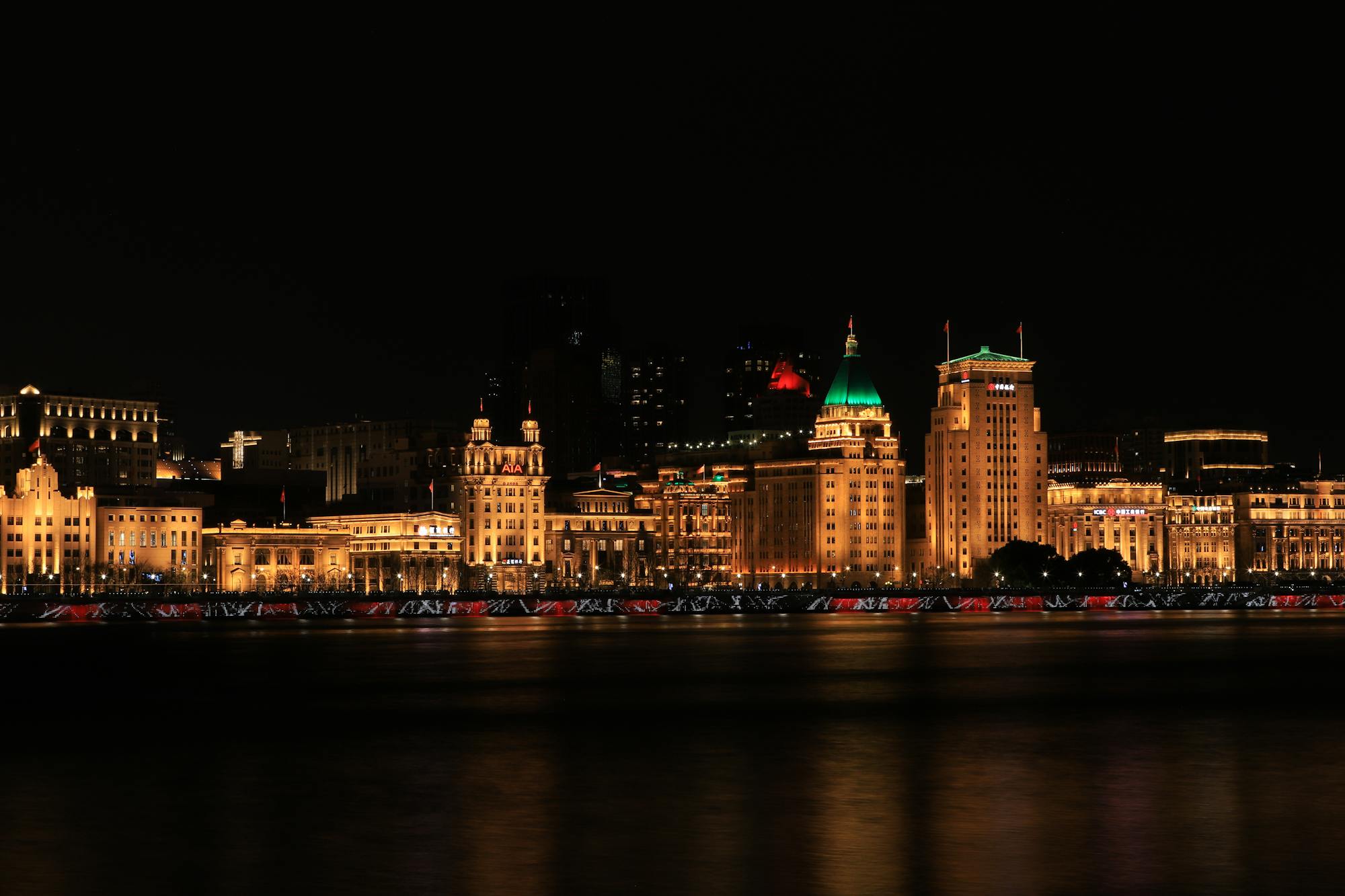
Shanghai is China's most cosmopolitan city — a place where 1930s art deco mansions line the Bund waterfront while Pudong's towers compete to redefine the skyline across the Huangpu River. The Former French Concession is a neighbourhood of leafy lanes, independent boutiques, and restaurants that would hold their own in any European city. Xintiandi blends heritage shikumen architecture with modern retail. And none of this comes at the expense of the fundamentally Chinese: the soup dumplings at Din Tai Fung, the morning crowds at People's Square, the night markets of the old city. Shanghai synthesises East and West more fluently than anywhere else in China.
- Suggested duration: 3–4 days
- Best time to visit: March–May and September–November. Summer is hot and humid; winter is mild but grey.
Shanghai is China's most cosmopolitan city — a place where 1930s art deco mansions line the Bund waterfront while Pudong's towers compete to redefine the skyline across the Huangpu River. The Former French Concession is a neighbourhood of leafy lanes, independent boutiques, and restaurants that would hold their own in any European city. And none of this comes at the expense of the fundamentally Chinese: the soup dumplings at old-school dim sum houses, the morning crowds at People's Square, the night markets of the old city. Shanghai synthesises East and West more fluently than anywhere else in China.
Why Visit Shanghai
Shanghai suits travellers who want the full spectrum of China's contradictions compressed into a single, endlessly walkable city. It is simultaneously the most modern and the most historically layered of China's major cities — a place where a French colonial villa houses a Michelin-starred restaurant, where colonial-era longtang alleyways survive in the shadow of 500-metre towers, and where a single evening can take you from a century-old teahouse in the Old City to a rooftop bar above Lujiazui's neon forest. First-time visitors to China often find Shanghai the easiest city to navigate, with excellent English signage and a cosmopolitan ease that other Chinese cities are still developing.
Top Attractions and Experiences
The Bund (Waitan) is Shanghai's most iconic promenade — a kilometre of neoclassical and art deco banking palaces facing the futuristic towers of Pudong across the river. Walk it at night when both shores are fully illuminated and the effect is startling. The Former French Concession is the city's most atmospheric neighbourhood: tree-lined streets (particularly Wukang Road and Fuxing Road) of plane trees, 1930s villas, boutique cafes, and the best independent restaurants in the city. Yu Garden (Yuyuan) in the Old City is a classical Ming-dynasty garden of rockeries, pavilions, and carp ponds, surrounded by a bazaar of teahouses and street food stalls — best visited on a weekday morning before the crowds arrive. The Shanghai Museum on People's Square holds one of China's finest collections of bronzes, ceramics, and calligraphy. And for a purely contemporary Shanghai experience, the Power Station of Art contemporary museum in a converted power plant, and the creative cluster of M50 art galleries in Moganshan Lu, show the city's thriving cultural scene.
Getting There and Around
Shanghai Pudong International Airport (PVG) handles most international arrivals, with a Maglev train connecting it to the metro system in 8 minutes at 430 km/h — one of the world's great airport transfers. Hongqiao Airport (SHA) handles domestic and some regional flights, and is also the main high-speed rail terminus for trains to Beijing (4.5 hours), Hangzhou (45 minutes), and Suzhou (30 minutes). Shanghai's metro is one of the world's largest and most efficient, with clear English signage; a rechargeable metro card is the easiest way to get around. Taxis and DiDi are affordable and essential for late-night journeys. The city's historic tram line along the Bund is a scenic way to travel between sights.
Best Time to Visit
Spring (March to May) and autumn (September to November) are Shanghai's finest seasons — warm, relatively dry, and with the city's plane trees providing golden canopy cover in the French Concession. Summer (June to August) is hot, humid, and subject to typhoons; winters are mild but grey. The city is less affected by the national holiday crowd surges than Beijing's imperial sites, though the Bund and Yu Garden become very busy during Golden Week (1–7 October).
Local Culture and Food
Shanghai's food culture is one of China's richest. Xiaolongbao — steamed soup dumplings encasing a ball of seasoned pork and intensely flavoured broth — are the city's most celebrated contribution to Chinese cuisine. The technique for eating them is precise: place in a spoon, nip a small hole in the skin to release the steam, add a dash of vinegar and ginger, then consume whole. Din Tai Fung and Jia Jia Tang Bao are the most famous addresses, but neighbourhood xiao long bao shops are everywhere and often better. Shengjianbao (pan-fried pork dumplings with a crispy base) are the street-food companion. Beyond dumplings, Shanghainese cuisine is known for its red-braising technique — pork belly, fish, and tofu slow-cooked in soy sauce, Shaoxing wine, and sugar until deeply lacquered — and for the extraordinary cold dishes (hong shao kao fu, smoked fish) that precede every formal meal. The French Concession is also the epicentre of Shanghai's specialty coffee culture, with independent roasters rivalling the best in Tokyo or Melbourne. Tipping is not customary.