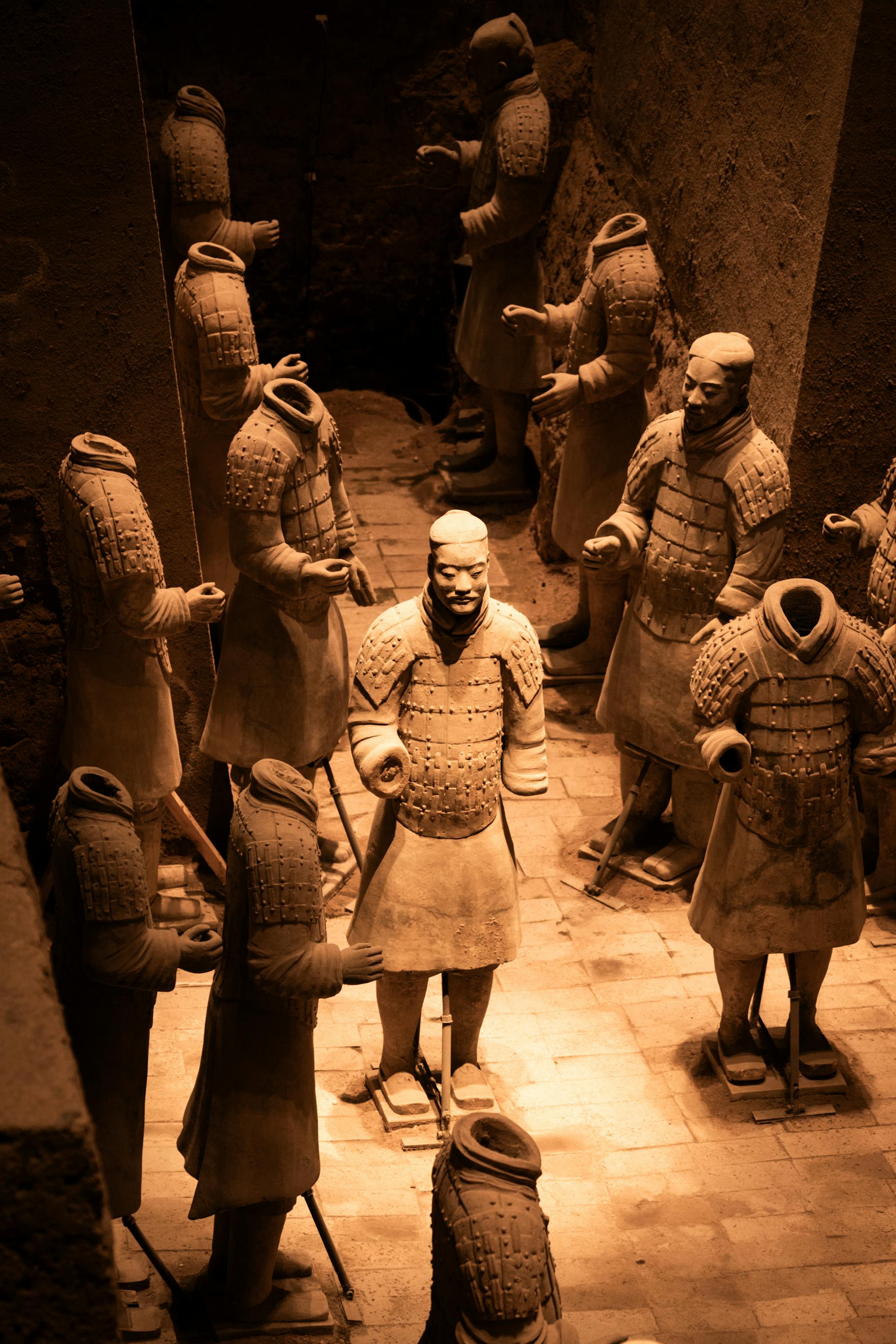
Xi'an was China's capital for over a thousand years and the eastern terminus of the Silk Road — and it wears that history more visibly than almost any other city in the country. The Terracotta Army, buried with China's first emperor Qin Shi Huang, is one of the most spectacular archaeological discoveries of the twentieth century: thousands of life-size warriors standing in silent formation beneath a series of excavation pits. But Xi'an rewards those who stay for the city itself: the 14km Ming Dynasty wall is best cycled at sunset, the Muslim Quarter is a labyrinth of lamb skewers and biangbiang noodle shops, and the Great Mosque — an extraordinary fusion of Islamic and Chinese architecture — is one of the finest buildings in the country.
- Suggested duration: 2–3 days
- Best time to visit: Spring (April–May) and autumn (September–November) are ideal. Summers are warm and busy around the Terracotta Army.
Xi'an was China's capital for over a thousand years and the eastern terminus of the Silk Road — and it wears that history more visibly than almost any other city in the country. The Terracotta Army, buried with China's first emperor Qin Shi Huang, is one of the most spectacular archaeological discoveries of the twentieth century: thousands of life-size warriors standing in silent formation beneath a series of excavation pits. But Xi'an rewards those who stay for the city itself: the 14km Ming Dynasty wall is best cycled at sunset, the Muslim Quarter is a labyrinth of lamb skewers and biangbiang noodle shops, and the Great Mosque — an extraordinary fusion of Islamic and Chinese architecture — is one of the finest buildings in the country.
Why Visit Xi'an
Xi'an suits travellers drawn to archaeology, ancient history, and the Silk Road cultures that shaped the world. It is also a surprisingly liveable, human-scaled city by Chinese standards — its historic core still enclosed within intact Ming Dynasty walls, its neighbourhoods walkable, its food scene extraordinary. For visitors doing a classic China itinerary of Beijing, Xi'an, and Shanghai, Xi'an provides the perfect middle chapter: less overwhelming than the megacities, with history that puts everything else in perspective.
Top Attractions and Experiences
The Terracotta Army (Museum of Qin Shi Huang Mausoleum) is the city's unmissable centrepiece. Three excavation pits house an estimated 8,000 warriors, 130 chariots, and 670 horses — each figure individually sculpted with unique facial features. Pit 1, the largest, is genuinely awe-inspiring in scale: 230 metres long, lined with ranks of armoured infantrymen. Pit 3 contains the command unit; Pit 2 the cavalry and mixed forces. Budget at least three hours, arrive early, and hire an audio guide or licensed guide to make the most of the extraordinary archaeological context. Back in the city, the Xi'an City Wall (Ming Dynasty, 1370s) is the most complete ancient city wall in China — 14 kilometres of fortifications you can walk or cycle entirely. Rent a bicycle at any of the gate entrances for the most enjoyable afternoon in the city. The Muslim Quarter (Huimin Jie) is Xi'an's most atmospheric neighbourhood: a dense network of alleys where the Hui Muslim community has lived since the Tang Dynasty, lined with lamb skewer grills, sesame flatbread stalls, and shops selling dried fruits and spices from across Central Asia. The Great Mosque (Daqingzhen Si), built in 742 AD, is the most beautiful in China — a series of courtyard gardens and prayer halls that seamlessly blend Islamic religious function with classical Chinese architectural style. The Shaanxi History Museum houses one of the finest collections of Tang Dynasty art in the world, free to enter (with advance ticket registration).
Getting There and Around
Xi'an Xianyang International Airport (XIY) has direct connections from Beijing, Shanghai, Chengdu, and several international destinations. High-speed trains connect Xi'an North station to Beijing (4.5 hours), Shanghai (5.5 hours), and Chengdu (3 hours) — the train is the preferred option for most domestic travellers. Within the city, the metro system now covers the main attractions, including a line to the Terracotta Army. Taxis and DiDi are cheap and plentiful. The old city within the walls is compact enough to explore by bicycle.
Best Time to Visit
Spring (April to May) and autumn (September to November) offer the most pleasant conditions — clear skies, moderate temperatures, and the city's parks in full colour. Summer is hot and can be humid; winter is cold but often dry and clear. Xi'an is less overwhelmed by domestic tourists than Beijing's imperial sites, though the Terracotta Army site is always busy — arriving at opening time (8:30am) gives you an hour ahead of most tour groups. Avoid the Golden Week national holidays (1–7 October) when visitor numbers spike dramatically.
Local Culture and Food
Xi'an's food is distinctive from the rest of China, reflecting its position as the gateway to Central Asia and its large Hui Muslim population. Biangbiang noodles — thick, hand-pulled belt-width noodles (the character used to write "biang" is the most complex in the Chinese written language) served with chilli oil, vinegar, garlic, and minced meat — are the city's signature dish and one of the great noodle experiences in the world. Roujiamo (braised spiced pork stuffed in a flatbread, sometimes called the "Chinese hamburger") is the ultimate street food. In the Muslim Quarter, yangrou paomo — a hearty lamb and bread soup assembled to order, with diners tearing the flatbread into small pieces for the cook to incorporate — is the definitive local experience. Cultural etiquette in Xi'an's Muslim Quarter: dress modestly, do not bring or consume pork products, and ask before photographing people at prayer. The Great Mosque is open to non-Muslim visitors but requires respectful dress — a scarf for women's hair is appreciated.