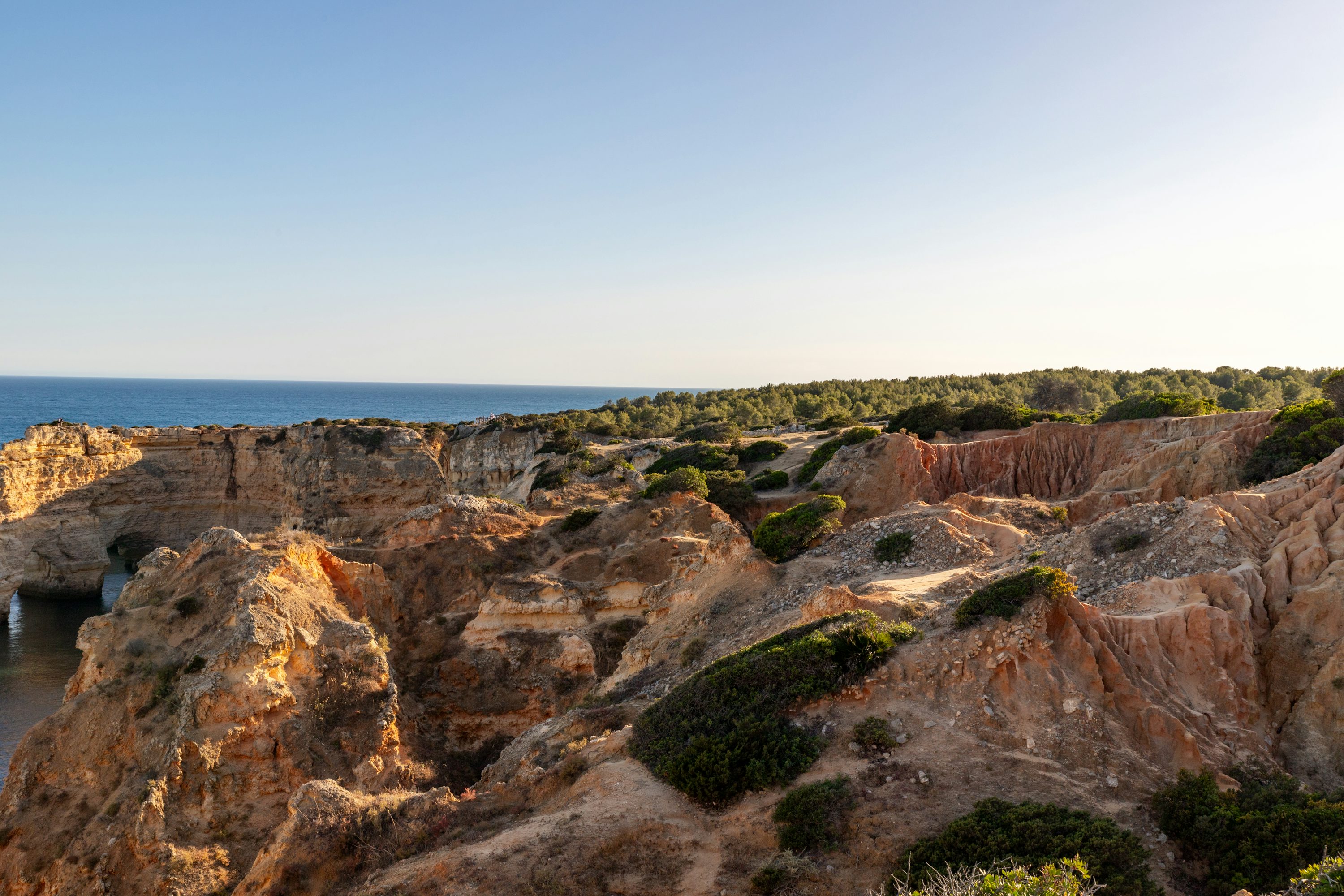
The Algarve — Portugal's sun-blessed southern coastline — is famous for its dramatic golden cliffs, hidden sea caves, and some of Europe's most beautiful beaches. But beyond the beach clubs and resorts, the Algarve offers excellent hiking, seafood dining, historic towns, and a wild, windswept coastline that feels like the edge of the world.
1. Things to Do in Algarve: Explore Ponta da Piedade and Lagos Sea Caves
Ponta da Piedade, just south of Lagos, is one of the defining sights along the Algarve’s stunning coastline, with weathered limestone cliffs, sandy coves, arches, sea stacks, grottos, and tunnels sculpted by centuries of Atlantic waves. Walk down the stepped path from the clifftop viewpoint for panoramic views or, better yet, rent a kayak from Lagos beach and paddle through the caves and arches at sea level. The golden light of late afternoon transforms the rocks into something otherworldly. Boat tours from Lagos also run through the grottos and are a good option if you don't kayak.
2. Visit Benagil Cave
Benagil Cave is one of Portugal's most photographed natural wonders on the Algarve coastline, where the area's natural beauty shines through arches, stacks, grottos, tunnels, and other rock formations that frame a cathedral-like sea cave with a natural circular skylight through which sunlight streams onto a small sandy beach and the turquoise waters below. It cannot be reached on foot and must be visited by kayak, paddleboard, or boat tour from the beach at Carvoeiro or Praia de Benagil, and many trips also pass Praia de Marinha and Marinha Beach nearby. Tours sell out quickly in summer; book ahead or rent a kayak for an independent exploration. Boat trips from this area can also include dolphin watching off the coast. Arrive early to avoid the crowds.
3. Surf at Sagres and Arrifana
The western Algarve around Sagres and the Costa Vicentina on the west coast is one of Europe's premier surf destinations, where the rugged shorelines and panoramic views add to the area's raw appeal. Sagres's Praia do Tonel and Mareta beaches pick up consistent Atlantic swells, while Arrifana — a dramatic cove backed by dark basalt cliffs and dramatic cliffs — offers some of the region's most spectacular surf scenery. The area is far less developed than the central Algarve and has a raw, elemental quality that surfers and nature lovers appreciate. Several surf schools in Sagres cater to all levels.
4. Explore the Old Town of Lagos
Lagos is the most characterful town on the Algarve’s west coast surf zone, its 16th-century walls enclosing a maze of whitewashed lanes, cobbled streets, baroque churches, and lively squares, with Sagres and Arrifana nearby beneath dramatic cliffs. The Igreja de Santo António is a Baroque masterpiece of gilded woodwork, and the adjacent Museu Regional de Lagos houses a fascinating collection of local artefacts. The town's Praça Gil Eanes and waterfront are lined with cafes and restaurants — Lagos has one of the Algarve's best food scenes, making it a great place to explore local cuisine, with excellent fresh seafood, fresh fish, and cataplana (seafood stew), a pan shaped by Arab traditions linked to North Africa. Inland routes in the Monchique area also suit mountain biking, with panoramic views from Foia peak.
5. Walk the Rota Vicentina
The Rota Vicentina is a network of long-distance walking trails through the Costa Vicentina natural park — the wildest and most unspoiled stretch of cobbled streets and old-town charm in Western Europe. The Fishermen's Trail (Trilho dos Pescadores) follows clifftop paths just above the crashing Atlantic, while the Historical Way winds inland through cork oak forests and traditional villages. Both trails can be walked in sections (day hikes) or end-to-end over 7–12 days, and the seven hanging valleys trail is a shorter coastal alternative along Algarve's coast, with a short walk option on some segments and a leisurely stroll feel on easier stretches, known for spectacular views over cliffs, coves, and rock formations. Accommodation in simple pensions and rural guesthouses is bookable along the route.
6. See Cape Sagres and the End of the World
Fortaleza de Sagres, a stone fortress perched on a dramatic promontory at Portugal's southwestern tip, was the legendary base of Henry the Navigator — the prince who organized Portugal's 15th-century voyages of exploration. The wind-battered clifftops feel genuinely elemental, and the views over the Atlantic Ocean crashing against the rocks from the fortress walls are extraordinary. The nearby Cabo de São Vicente lighthouse marks the westernmost point near the southwestern tip of mainland Europe — a symbolic "edge of the world" that still impresses after five centuries, with a handy car park for visitors arriving by road.
7. Take a Boat Trip Along the Ria Formosa
The Ria Formosa Natural Park, stretching along the central Algarve coast from Faro to Cacela Velha, is a protected lagoon system of extraordinary ecological richness, and from the fortress walls of Fortaleza de Sagres to the waterways near the town Faro, it frames some of the region’s most striking historic and natural scenery. Boat trips from Faro and Olhão weave through the lagoons and past salt pans to deserted barrier island beaches like Ilha Deserta and Ilha da Culatra — remote sandy strips with views out over the Atlantic Ocean, accessible only by boat. Faro Airport is the main gateway to this part of the Algarve, and the Roman ruins of Milreu near Faro add an easy cultural stop alongside the coast. The lagoons are also important for bird watching, particularly flamingos, spoonbills, and migratory waders in spring and autumn; if you're driving onward, Cabo de São Vicente lies at the southwesterly tip of Portugal on the headland often described in relation to mainland Europe’s westernmost point, and there is a nearby car park.
8. Explore Silves and the Interior Algarve
Silves, the former Moorish capital of the Algarve, is one of the region's most underrated towns. Faro Airport is the main international airport in the Algarve. Faro is also easy to reach from Lisbon by train in about 3–4 hours, by buses from major Portuguese cities, or by driving via major highways. Its red sandstone castle is quite a sight — the best-preserved Moorish fortification in Portugal — rising above old city walls, whitewashed houses, and hills dotted with orange trees. The gothic cathedral, built on the site of the Great Mosque, contains several Gothic tombs of Portuguese kings. The surrounding Serra de Monchique mountains offer hiking trails through eucalyptus and cork oak forests, and the spa town of Caldas de Monchique is a pleasant detour.
Loulé, an inland town with lively markets and preserved castle walls, is worth visiting for a more traditional side of the region. Its Islamic Baths are displayed in a small museum beneath the town, adding a useful stop between coastal resorts and rural villages. Castro Marim, a small town near the Spanish border, also appeals if you want quieter history and local character. Tavira is another of the Algarve’s hidden gems for churches, riverfront walks, and birdwatching. Its salt pans attract seasonal flamingos from November to March. The Roman Ruins of Milreu are located just outside Faro. Faro itself is easier to use as a base for exploring the surrounding town area than as a stop focused on parking near Cabo de São Vicente.
Best Algarve Beaches
The Algarve's best beaches range from sheltered rock-framed coves to vast Atlantic-swept sandy beaches, making it easy to plan a relaxed beach day around some of the region’s stunning beaches. Praia da Marinha (near Carvoeiro) is frequently listed among Europe's most beautiful beaches, and nearby stretches include more secluded beaches; the Carvoeiro Boardwalk is an easy coastal walk for cliff, cave, cove, and beach views. Meia Praia near Lagos is a long, family-friendly strand and one of many favourite beaches for visitors. Praia do Camilo (Lagos) is a picturesque staircase-accessed cove. In the east, the Tavira region's Ilha de Tavira offers a more tranquil, unspoiled experience beyond the main beach, and Santa Luzia is a small fishing village with a strong octopus tradition, fresh fish, and the feel of a traditional fishing village. Peak season (July–August) fills the most popular beaches; visit in June or September for warm water and far fewer crowds, while the off season also suits day trips to sleepy villages and any small village with a slower pace.