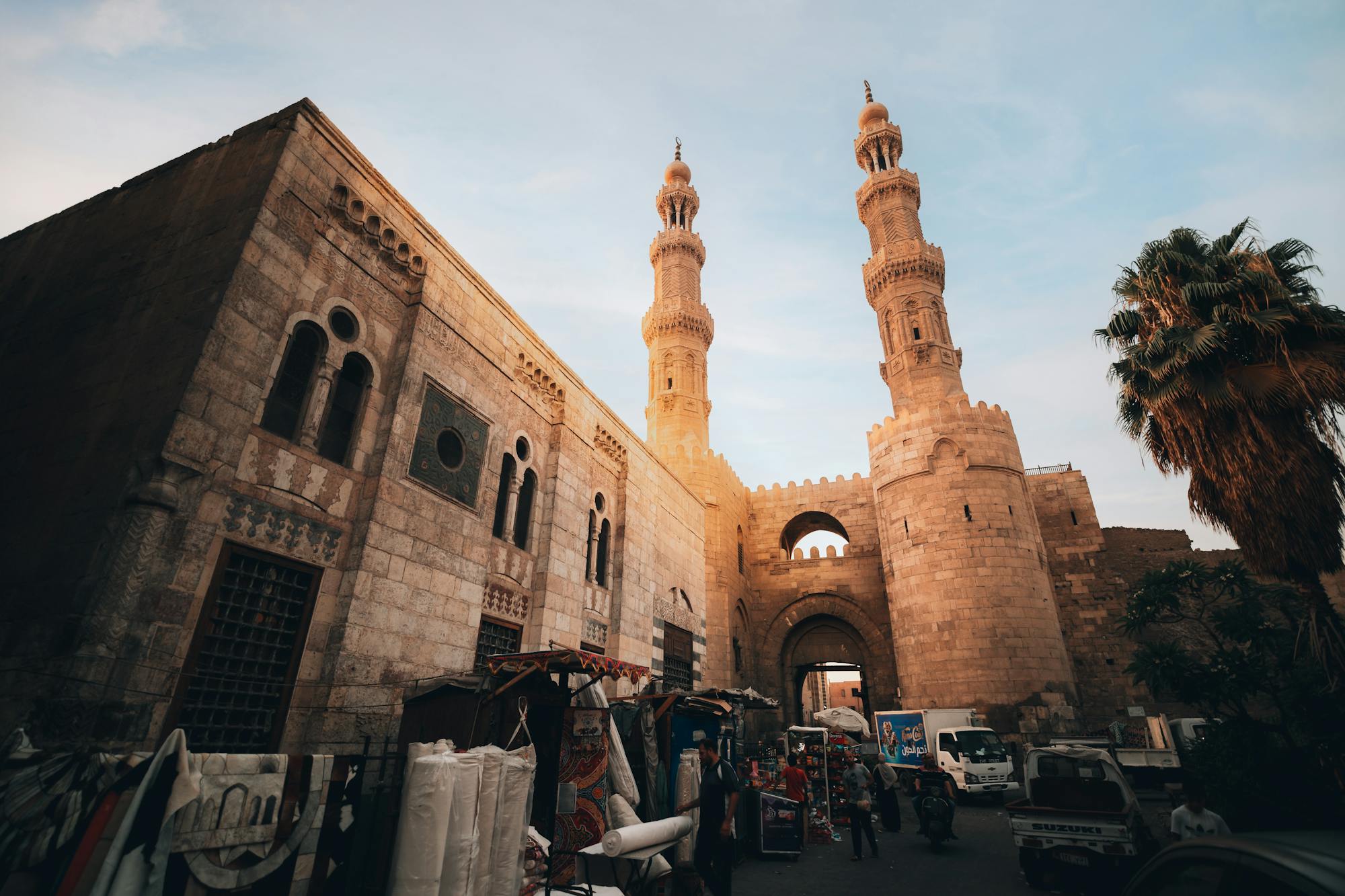
Cairo is one of humanity's great cities — a teeming, chaotic, magnificent megapolis of 20 million people that has been the Arab world's most important metropolis for over a millennium. The city is built on the confluence of Africa and the Middle East, of ancient pharaonic civilisation and medieval Islamic culture, of Coptic Christian heritage and modern pan-Arab identity.
Things to Do in Cairo: The Giza Pyramids and Sphinx
The Giza complex sits on the western plateau just outside Cairo, Egypt, on the Giza Plateau — a 20-minute drive from Downtown. The Great Pyramid of Khufu (c. 2560 BC) is the world's oldest and last remaining ancient wonder, a defining monument of ancient Egypt that shows how ancient Egyptians refined pyramid building into an extraordinary feat of scale and precision. Most visitors are surprised by how close the city comes to the monuments — suburban Cairo is literally visible from the base of the Sphinx. The plateau is the core monument zone and an easy base for a half-day or day trip from Cairo. Enter the pyramids (tickets purchased separately, numbers limited) for the extraordinary experience of crawling through millennia-old passages to the empty granite burial chambers. Sunrise visits offer the purest experience before the tour group coaches arrive.
The Egyptian Museum and Grand Egyptian Museum
The old Egyptian Museum on Tahrir Square (opened 1902), housed in a rose-pink Beaux-Arts building designed by French architect Marcel Dourgnon, holds 120,000 artefacts over two floors — a magnificent but overwhelming collection that includes the entire contents of Tutankhamun's tomb, with with a separate ticket required to enter the Royal Mummies Room and still displaying tens of thousands of objects that illuminate Egyptian civilisation and Egypt's history despite the newer museum opening; for a more streamlined national museum experience, many visitors also compare it with the National Museum of Egyptian Civilization. The new Grand Egyptian Museum (GEM), adjacent to the pyramids, is now open — a purpose-built facility of 480,000m² designed by Heneghan Peng Architects and set to be the largest museum dedicated to Egyptian antiquities, with purpose-curated galleries for the Tutankhamun treasures, the royal mummies, and a spectacular atrium with a colossal statue of Ramses II, while iconic pieces such as the Rosetta Stone are in the British Museum rather than Cairo museums. Visitors interested in modern Egyptian art and Egyptian artists should also consider the Museum of Modern Egyptian Art at Cairo Opera House.
Allow a full day for the GEM alone.
Islamic Cairo
Islamic Cairo — one of the defining historic districts of Egypt's capital and part of the wider Middle East heritage landscape — contains the greatest concentration of Islamic architecture in the world: over 600 mosques, madrasas, mausoleums, and caravanserais built between the 7th and 19th centuries, in a UNESCO World Heritage site. The Al-Azhar Mosque (970 AD), the world's oldest functioning university, anchors the district. The Amr Ibn Al As Mosque, dating to 642 AD, is the oldest mosque in Egypt and an important stop in Old Cairo's Islamic history. The Khan el-Khalili bazaar — Egypt's greatest souk, in continuous operation since 1382 — is a warren of gold, spice, papyrus, and silver merchants. Its busy streets are part of the district's atmosphere, but if you're visiting Cairo, stop for a coffee at El Fishawy, a coffeehouse that has stayed open around the clock since 1773 and counts Nobel laureate Naguib Mahfouz among its regulars. The Cairo Citadel of Saladin, built in 1176 AD, commands the city from a hill with views across the minarets and served for centuries as a seat of power for Egypt's rulers — the Muhammad Ali Mosque (1848) inside its walls reflects the legacy of Mohammed Ali and is one of Egypt's most beautiful Ottoman-style buildings, often compared to the Blue Mosque for its domes and minarets. Early in the day, the Citadel can feel calmer than the city's biggest headline sights, with very few tourists compared with the busiest attractions. The Ibn Tulun Mosque is another standout monument of Islamic architecture.
Coptic Cairo
Coptic Cairo — the ancient Christian quarter in Old Cairo (Misr al-Qadima) — contains some of Egypt's most significant early Christian monuments and reflects an important layer of North Africa's Christian heritage. The Hanging Church (Coptic Museum), suspended above the gatehouse and Roman Tower substructure of the Roman fortress of Babylon, is the most famous Coptic church in Egypt. Nearby, the Church of the Cavern is tied in Christian tradition to the Holy Family's stay in Egypt. The Coptic Museum beside it houses the world's finest collection of Coptic Christian art. The nearby Ben Ezra Synagogue, where legend holds that Moses was found in the bullrushes, was restored in the 1980s and is one of the oldest synagogues in Africa. Nearby sites such as the Cave Church in Mokattam and the area known as Garbage City show another side of Cairo's Christian communities.
Day Trips from Cairo
The Saqqara necropolis (30km south) contains the Step Pyramid of Djoser — Egypt's oldest pyramid (c. 2650 BC) and the world's oldest large stone structure — surrounded by a complex of dummy buildings and ceremonial courts. Memphis (nearby, Egypt's first capital) has a small open-air museum with a colossal fallen limestone statue of Ramesses II, a striking link to Egypt's rulers across its long history. Dahshur (40km south) contains the Bent Pyramid and Red Pyramid — less visited than Giza and often accessible without crowds. If you want a break from chaotic Cairo, Al Azhar Park offers Citadel views and on site restaurants in a calmer setting. The 30-hectare park was reclaimed from a centuries-old rubble dump by the Aga Khan Trust for Culture, opening in 2005, and its restoration works uncovered a long-buried stretch of the Ayyubid city wall. Together, Saqqara, Memphis, and Dahshur can be combined into a single day trip, typically visited in that order — Saqqara first, then Memphis, then Dahshur — before returning to Cairo by early evening. For a classic city experience on the River Nile side of town, on Gezira Island in Zamalek, Cairo Tower is the city's tallest structure, and its revolving restaurant near the top gives 360-degree views over the Nile. A felucca ride or Nile Cruise departing at sunset from the Garden City or Zamalek corniche also works well for dinner, with belly dancing on some evening sailings. Abou Tarek, just off Tahrir Square in Downtown, serves koshari — Egypt's national dish of rice, lentils, macaroni, and chickpeas under a spiced tomato sauce and crisp fried onions — across several floors that stay busy well past midnight. Shoulders and knees should be covered when entering mosques and churches, and headscarves are available to borrow at the door of Al-Azhar and the Muhammad Ali Mosque when you visit Egypt.