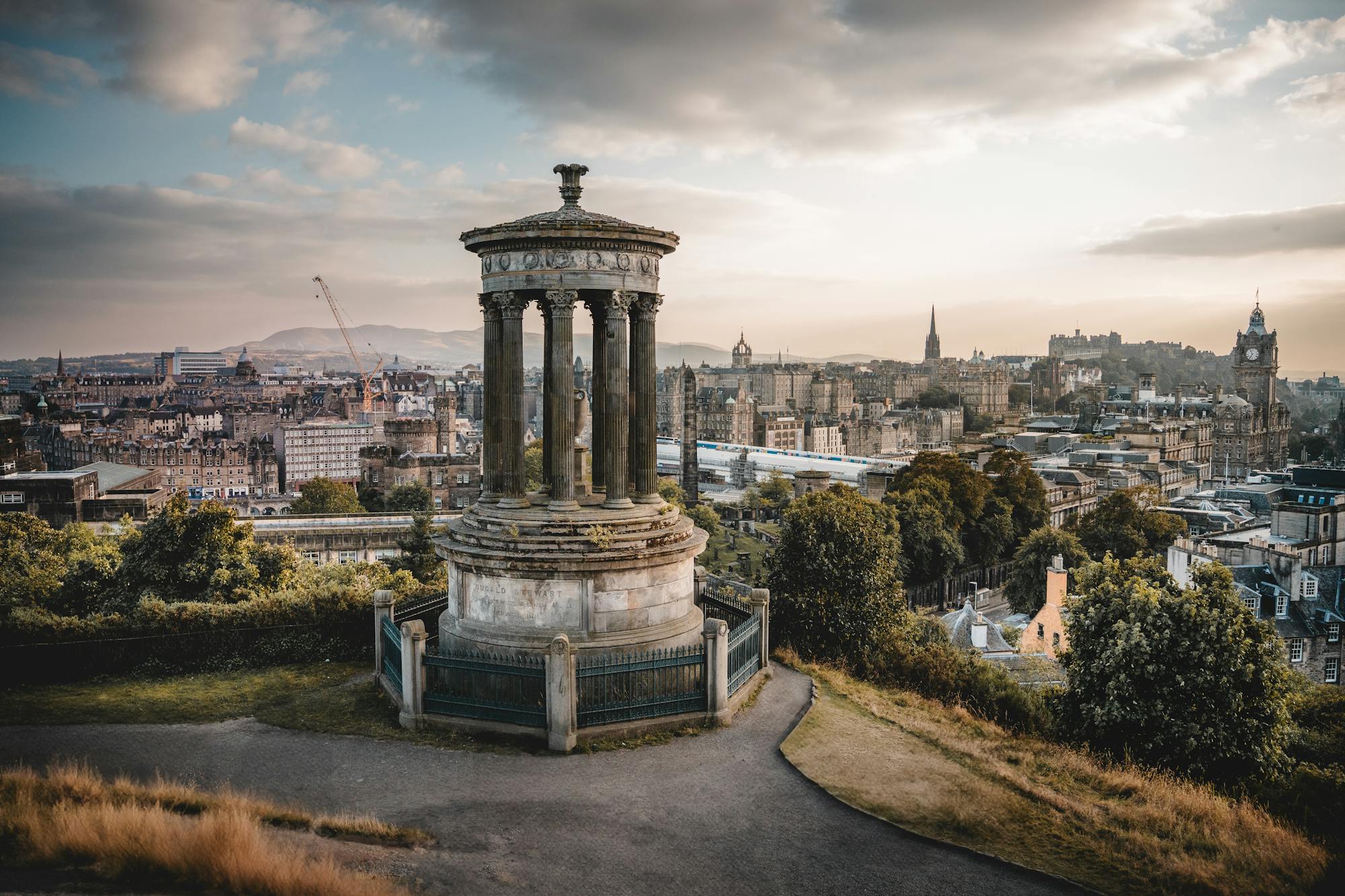
Edinburgh is one of Europe's most dramatically beautiful capitals — a city of volcanic crags, medieval tenements, Georgian New Town elegance, and a cultural vitality that punches far above its modest size. In August, it becomes the undisputed festival capital of the world, hosting the Edinburgh Festival Fringe — the world's largest arts festival. At any time of year, Edinburgh is magnetic.
Edinburgh is one of Europe's most dramatically beautiful capitals — a city of volcanic crags, medieval tenements, Georgian New Town elegance, and a cultural vitality that punches far above its modest size. Built on and around the ancient volcanic plug of Castle Rock, the Scottish capital rewards visitors with breathtaking views at every turn, an extraordinary concentration of museums and galleries (most free), a whisky culture of serious depth, and a warmth of welcome that surprises many first-time visitors. In August, it becomes the undisputed festival capital of the world. At any time of year, Edinburgh is magnetic.
Things to Do in Edinburgh: Must-See Attractions
If you're deciding on the best things to do in Edinburgh, start with the essentials: visit Edinburgh Castle, perched atop its volcanic crag, visible from across the city, and attracting around 2.2 million visitors annually as Scotland's most visited attraction. Inside, the Scottish Crown Jewels (older than England's by a century), the Stone of Destiny, and the Great Hall reward the entrance fee.
Walking down Edinburgh's historic Royal Mile — the main street of the Old Town connecting the castle to the Palace of Holyroodhouse — takes you past centuries of history and surrounding historic buildings: St Giles' Cathedral, with its distinctive crown spire and roots in the 12th century, the medieval closes and wynds, and the Scottish Parliament building at the foot. Holyrood Palace, the official Scottish residence of the monarch, offers guided tours of the state apartments and the ruined Holyrood Abbey. Calton Hill, a 10-minute walk from Princes Street, offers some of the best panoramic views in Scotland's capital — the classical monuments, the castle in the distance, the Firth of Forth, and on clear days the North Sea.
For travellers planning a cultured, well-paced city break — especially those looking for a more curated or luxury stay — Edinburgh combines landmark sights with food, whisky, neighbourhoods, and easy day trips, so it rewards a thoughtful itinerary. Arthur's Seat, the ancient volcano within Holyrood Park, is a 45-minute climb to 251 meters above sea level, rewarded with extraordinary 360-degree views; it's remarkably wild for a hike that starts in a capital city. The National Museum of Scotland on Chambers Street is a world-class free museum tracing Scotland's history and culture from prehistoric times to the present, including Dolly the sheep. Edinburgh also has other free museums, including the Scottish National Gallery, a leading national gallery in Scotland's capital, and the Scottish National Portrait Gallery, which is also free to enter, helping visitors explore world cultures alongside the story of the city.
Cultural Experiences: Edinburgh Castle and More
Edinburgh's whisky culture is inseparable from its identity. The Scotch Whisky Experience beside the Castle offers excellent introductory tastings, access to a tasting room, and the world's largest collection of Scotch whisky bottles, though some upgraded tastings come at an extra cost. Nearby, Camera Obscura is another classic attraction close to the castle, known for interactive exhibits and optical illusions, and it has been operating since 1835, using mirrors and natural light to create live city views. It also features the city's oldest CCTV system from 1835. For a deeper experience, visit specialist whisky bars like Cadenhead's on the Royal Mile or the legendary Bow Bar on Victoria Street, where knowledgeable staff can guide you through drams from every Scottish whisky region. Victoria Street itself — a curved, cobbled street of colourful shopfronts — is arguably Edinburgh's most photogenic spot, said to have inspired the Diagon Alley of the Harry Potter books (J.K. Rowling wrote much of the series in Edinburgh). If you're a fan, head to Greyfriars Kirkyard for Harry Potter character name inspirations and Tom Riddle's grave. The kirkyard is also famous for the legend of Greyfriars Bobby. The Grassmarket, at the base of the castle rock, was historically the site of public executions and is now a lively square of pubs, restaurants, and independent shops. Edinburgh's New Town, built in the 18th century to a grand Georgian plan, is a UNESCO-listed masterpiece of urban planning — Charlotte Square, George Street, Rose Street, Princes Street Gardens, the Scott Monument, a 61-meter landmark honoring Sir Walter Scott, and the Dean Village are highlights. It's one of those areas visitors often list among their favourite places, and Cockburn Street is a useful, atmospheric link between the Old Town to the New Town, so you won't miss an easy route between the two while exploring the city's rich history. The Scottish National Portrait Gallery is a standout cultural stop here and one of the city's key Scottish National institutions. Circus Lane is a short walk away and one of the area's best hidden gems.
Day Trips and Excursions Along the Royal Mile
The Scottish Highlands begin just an hour north of Edinburgh, making day trips to some of Scotland's most spectacular scenery entirely feasible. The Loch Ness and Inverness route (3–3.5 hours each way by car or tour bus) passes through the Cairngorms and along the shores of the famous loch. Closer to Edinburgh, the Stirling Castle and Loch Lomond combination is accessible in a long day; Stirling Castle is where Mary Queen of Scots was crowned at nine months old. The charming fishing village of Crail and the other East Neuk of Fife villages are a 90-minute drive across the Forth Road Bridge, offering dramatic coastal scenery, fresh seafood, and historic harbours. The Rosslyn Chapel — made famous by The Da Vinci Code — is just 20 minutes south of Edinburgh by bus and is a genuinely extraordinary example of medieval stonemasonry.
Local Food and Drink Scene: The Scotch Whisky Experience
Edinburgh's food scene has transformed dramatically over the past decade, earning the city a growing roster of Michelin-starred restaurants. Traditional Scottish dishes are worth seeking out: haggis (oatmeal, onion, and offal cooked in a sheep's stomach — tastier than it sounds), cullen skink (smoked haddock and potato soup), and cranachan (raspberries with cream, oatmeal, and whisky) are quintessential. The Grassmarket and Canongate areas have excellent restaurant concentrations. The Leith neighbourhood — Edinburgh's port district — has become the city's most exciting food destination, with acclaimed restaurants like Martin Wishart (Michelin-starred) and The Kitchin alongside craft beer bars, fishmongers, and the Sunday Leith Market. You can also book chocolate workshops where you make a chocolate bar and take home your very own chocolate bar. Valvona & Crolla on Elm Row is Scotland's oldest Italian deli and a legendary food institution. For breakfast, seek out one of the city's traditional Scottish cafés for porridge with salt (the traditional way) and a bacon roll.
Tips for Getting Around
Visiting Edinburgh is easy on foot because many key sights sit close together in Edinburgh Scotland. The main attractions along the Royal Mile and up to Calton Hill and Arthur's Seat are all on foot. If you want to explore 17th-century life near the Royal Mile, The Real Mary King's Close is an easy stop. The New Town is a 15-minute walk from the Old Town through Princes Street Gardens. Scenic Dean Village is where the Water of Leith Walkway starts, making it an easy detour. From the centre, the royal botanic garden is another straightforward outing; the Royal Botanic Garden Edinburgh is a leading botanical institution, and the rock garden is one of its standout areas. If you want a quieter outing, the Hermitage of Braid is a good option for peaceful woodland hikes. Lothian Buses run frequent, reliable services across the city and are the main public transport option; a day ticket offers unlimited travel and excellent value. The Edinburgh Trams connect the Airport to York Place in the city centre and have recently extended to Newhaven/Leith. Taxis are readily available throughout the city. For the Edinburgh Fringe in August, walking is the only sane option — the city is packed and all venues are concentrated in the centre. During festival season, allow extra time for short walks and expect transport delays. Download the Lothian Buses app for real-time bus tracking. Note that parking in central Edinburgh is extremely limited and expensive; arriving by train (Edinburgh Waverley station, in the heart of the city) is far preferable. Many visitors use this central area to link several free things in one day without needing transport.