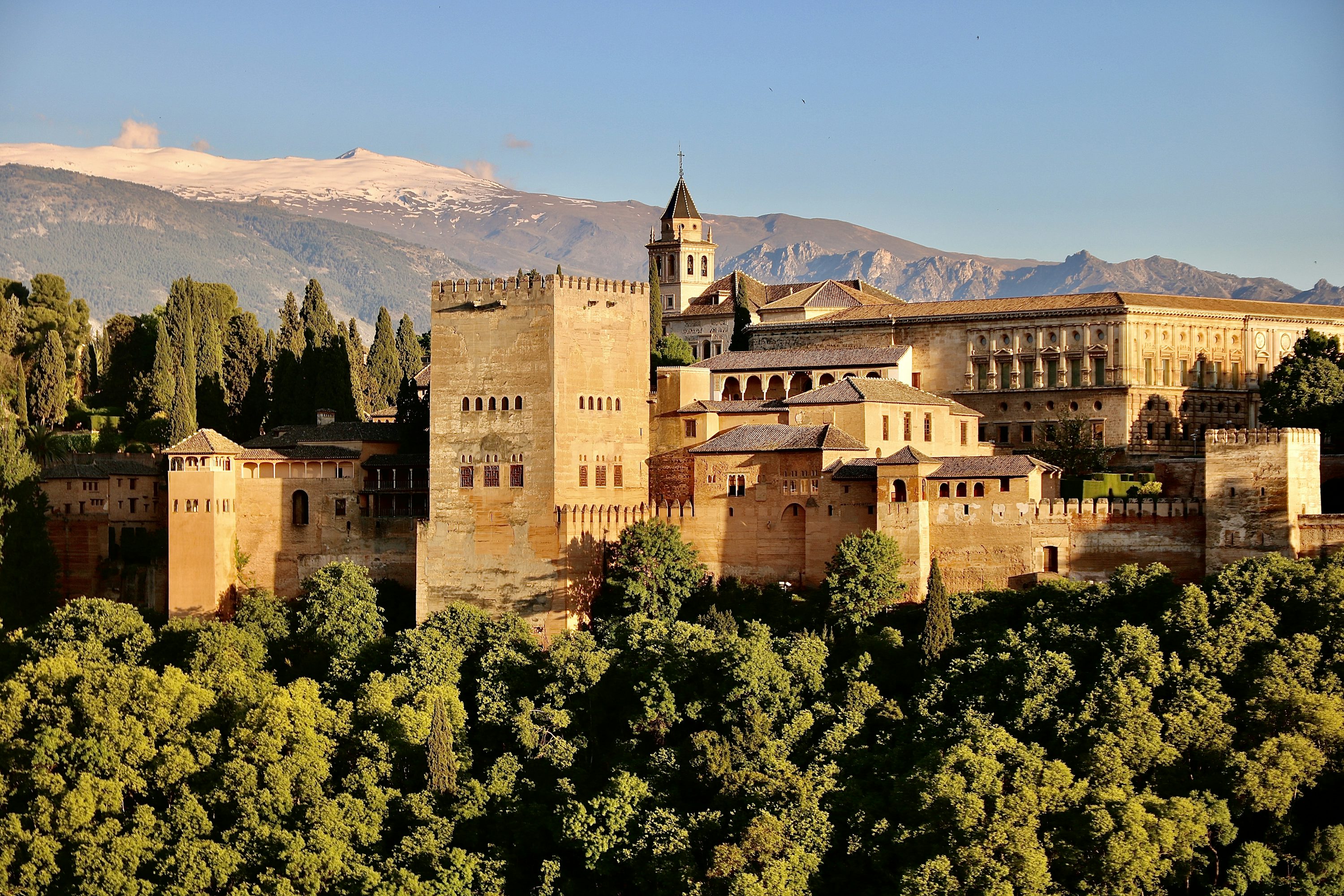
Granada is one of Spain's most extraordinary cities — a place where the Moorish past is not merely a museum exhibit but an overwhelming physical presence in the form of the Alhambra, the most beautiful palace complex in the Western world. Below the palace, the Albaicín neighborhood preserves the medieval street plan of the Moorish city, while the caves of Sacromonte are home to Granada's flamenco tradition. And uniquely in Spain, the tapas here are still free with every drink. Here are the best things to do in Granada.
1. Things to Do in Granada: Visit the Alhambra
The Alhambra is Spain's most visited monument and one of the most important examples of Islamic art, Moorish architecture, and design in the world. Built by the Nasrid sultans in the 13th and 14th centuries on a forested hill above Granada, in southern Spain, it comprises the Nasrid Palaces (the artistic heart — intricate stucco work, geometric tile mosaics, muqarnas ceilings, and serene water gardens), the Alcazaba (the military fortress with panoramic views), and the Generalife (the summer palace with extraordinary garden terraces above the city).
Critical tip: The Alhambra strictly limits daily visitor numbers. Nasrid Palace tickets sell out weeks — sometimes months — in advance. Book online at www.alhambra-patronato.es as early as possible. The Alhambra is one of Granada's most popular tourist attractions, and a guided tour can add valuable historical context. Without a Nasrid Palace ticket, you can visit the rest of the Alhambra, but the palaces themselves are the essential experience.
2. Explore the Albaicín
The Albaicín — Granada's ancient Moorish quarter across the Darro valley from the Alhambra, with Carrera del Darro running below — is a UNESCO World Heritage Site of narrow cobbled streets, whitewashed buildings, Arab tea houses (teterías), and Moorish-era carmenes (walled garden houses). The neighborhood climbs the hillside in a labyrinth of steep streets that reward those who lose themselves in them, with Calle Calderería Nueva adding to the area's Moorish atmosphere. The Mirador de San Nicolás, also known as Mirador de San Nicolas, — a viewpoint above the Albaicín — offers the most photographed view of the Alhambra: the palace complex glowing red against the snow-capped Sierra Nevada, where locals gather at sunset for views of the Alhambra. Below on the opposite side of the hill, Paseo de los Tristes makes a scenic continuation.
3. Experience Flamenco in Sacromonte
Granada's Sacromonte neighborhood, on the hill beyond the Albaicín, is home to one of Spain's oldest and most distinctive flamenco traditions — the zambra, performed in whitewashed cave dwellings (cuevas), with historic cave houses and steep narrow streets carved into the hillside. Cave flamenco shows in Sacromonte are more intimate and raw than tablao performances in Seville, with flamenco performances staged in small caves so each flamenco show feels intensely close, and the guitar playing adds to what a theatre cannot replicate. Several reputable cueva companies offer evening shows with transport included. Many visitors come here to watch flamenco as a living form of traditional flamenco art.
4. Enjoy Free Tapas
Granada maintains one of Spain's most beloved traditions: free tapas with every drink. Order a beer, glass of wine, or tinto de verano at any bar in the city center or Albaicín, and a plate of food arrives as a free plate, not at an extra cost — it might be a montadito (small open sandwich), a stew, a portion of jamón, or a fried snack. The tapas are assigned by the bar (you don't choose), and regulars strategically move between bars to collect the most generous offerings. The area around Calle Navas and the Plaza Nueva is packed with excellent tapas bars, including Los Diamantes, and whether you stay in the same place for one round or hop between local bars, the tradition makes it easy to eat well and save money. A food tour is another easy way to understand Granada's tapas culture.
5. Visit the Capilla Real (Royal Chapel)
The Capilla Real (Royal Chapel) adjacent to Granada Cathedral is the mausoleum of Ferdinand and Isabella — the Catholic Monarchs who reconquered Granada from the Moors in 1492 and sent Columbus to the Americas. Their ornately decorated tombs, and those of their daughter Juana "la Loca" and her husband Philip "el Hermoso," are among the most important royal monuments in Spain. The sacristy displays their personal crown jewels, scepters, and a remarkable collection of Flemish paintings from their personal collection.
6. Walk the Paseo del Darro
The Paseo del Darro, along the more commonly referenced Carrera del Darro, follows the Río Darro through a narrow valley between the Albaicín hill and the Alhambra hill — one of the most atmospheric walks in Spain. It continues toward Paseo de los Tristes, a scenic riverside stretch with Alhambra views and an easy way to reach viewpoints on the opposite side of the valley. The river is visible below the stone road surface, rushing beneath ancient bridges, and the path is flanked by Renaissance mansions, Arab baths, and medieval churches. The Arab Baths of El Bañuelo (11th century), an Arab bath and among the best-preserved Moorish bathhouses in Spain, are free to enter.
7. Take the Tram to the Sierra Nevada
Granada is the only European city with a ski resort within 45 minutes of its center, thanks to its proximity to the Sierra Nevada mountains. The Sierra Nevada ski resort (2,100–3,300 meters) is Spain's largest and highest, with 107 runs and extraordinary views toward the coast of North Africa on clear days. The resort typically opens December to April, and without a car, getting there usually means using public transportation. In summer, the high plateau above the ski resort is excellent for hiking among wildflowers and ibex, with the Mulhacén — the highest peak in mainland Spain (3,479m) and the highest mountain in the country — accessible to fit hikers.
8. Visit the Monasterio de la Cartuja
The Cartuja Monastery, on the northern edge of Granada, contains one of the most extraordinary examples of Spanish Baroque interior decoration anywhere — the sacristy, completed in 1764, is a riot of Churrigueresque ornament that covers every surface with marble, jasper, tortoiseshell, and silver, creating an effect that teeters between overwhelming beauty and deliberate excess. It is one of Spain's most surprising and least-visited great monuments.
9. Explore Granada Cathedral
Granada Cathedral, begun in 1521 on the site of the city's main mosque, the former Great Mosque, is one of the largest cathedrals in Spain — a massive Renaissance structure with a circular main nave designed by Diego de Siloé that gives it a uniquely spatial, light-filled interior quite different from Spain's Gothic cathedrals. The facade is a Baroque addition of considerable exuberance. Together with the adjacent Royal Chapel, it forms the religious heart of post-Reconquista Granada, reflecting the city's layered history on the Iberian Peninsula.
10. Day Trip to Las Alpujarras
Las Alpujarras — on the southern slopes of the Sierra Nevada in southern Spain — contain a series of Berber-influenced white villages perched above the valleys at altitudes of 1,000–1,500 meters. Villages like Pampaneira, Bubión, and Capileira have whitewashed flat-roofed houses and whitewashed houses decorated with esparto-grass chimney pots, local textile workshops, and extraordinary views of the mountains above and the coast below. The area was the last refuge of the Moriscos (Muslim converts to Christianity) after the Reconquista and retains a distinctly North African character.