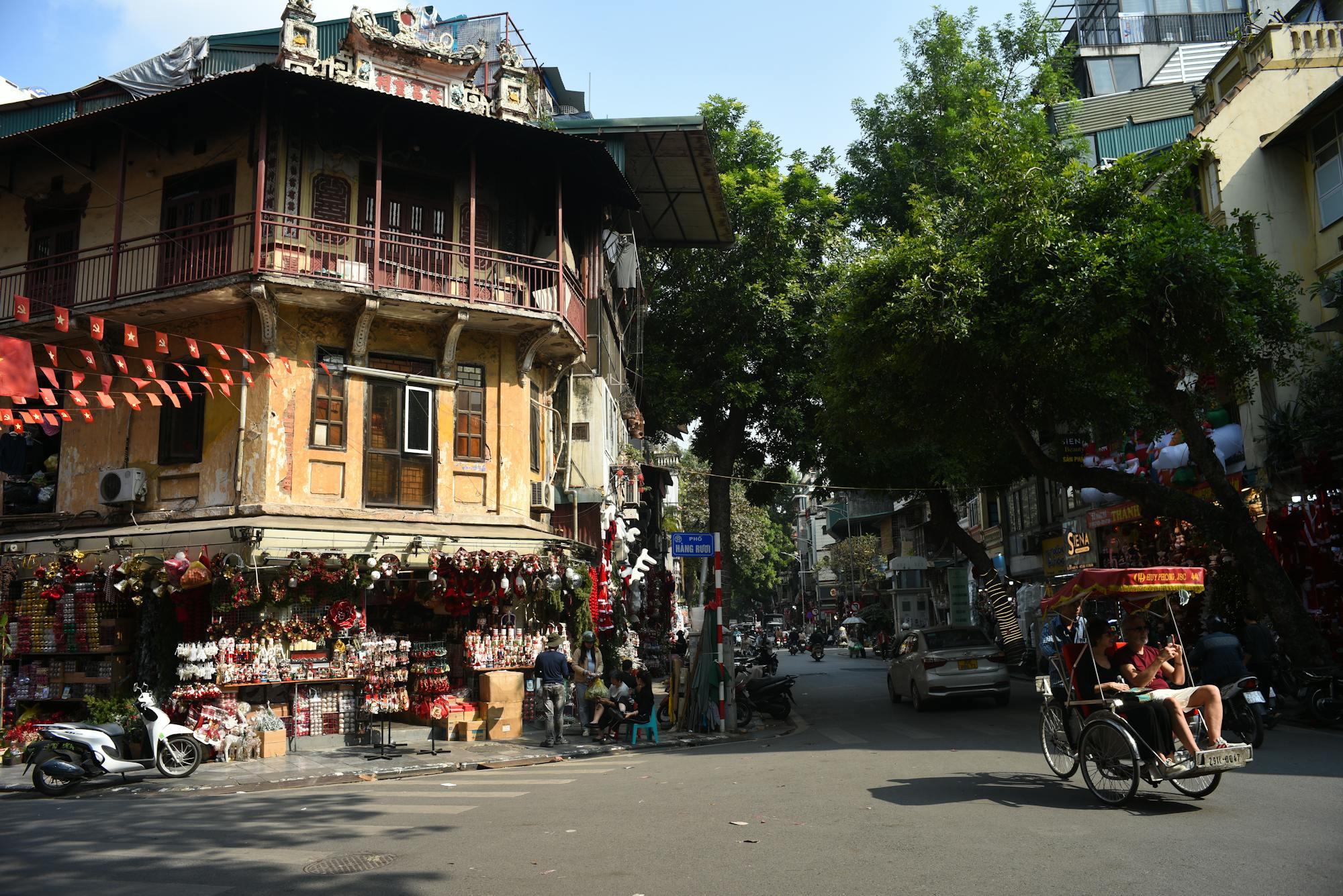
Hanoi is one of Southeast Asia's most atmospheric capital cities — a place of ancient trading streets, French colonial architecture, vivid street food culture, and profound historical monuments that rewards slow, exploratory travel.
Explore the Old Quarter
Hanoi's Old Quarter is one of Southeast Asia's most atmospheric urban districts. Thirty-six ancient trading streets, each historically named after the goods sold there — silk, paper, tin, bamboo — weave together in a dense labyrinth of shop-houses, temples, and street stalls. Walking these lanes in the early morning, when motorbike traffic is light and vendors set up their stalls, is one of the great city experiences in Asia. Hang Gai (Silk Street), Hang Ma (Paper Street), and Hang Buom are particularly rewarding to explore on foot.
Hoan Kiem Lake and Ngoc Son Temple
At the heart of the city, Hoan Kiem Lake (Lake of the Restored Sword) is Hanoi's spiritual and social centre. Legend holds that Emperor Le Loi returned a magical sword to a giant golden turtle here in the 15th century — a story that still resonates with locals. The red-lacquered Huc Bridge leads to Ngoc Son Temple, a serene shrine perched on a small island dedicated to the scholar Van Xuong, General Tran Hung Dao, and the physician La To. Morning tai chi practitioners and evening strollers give the lakeside a timeless rhythm.
Ho Chi Minh Mausoleum Complex
Uncle Ho's preserved body lies in state in a grey granite mausoleum modelled on Lenin's tomb in Moscow. The complex includes the Presidential Palace, Ho Chi Minh's stilted house where he preferred to live over the palace, a tranquil lotus pond, and the Ho Chi Minh Museum. Dress respectfully, maintain silence, and be prepared for long queues — but the experience is a powerful window into Vietnamese revolutionary history and the cult of Ho Chi Minh.
Temple of Literature
Founded in 1070 and dedicated to Confucius, the Van Mieu–Quoc Tu Giam (Temple of Literature) served as Vietnam's first national university for nearly eight centuries. Five walled courtyards contain pavilions, stone stelae recording the names of 1,307 doctoral graduates from 1484 to 1779, and a serene garden atmosphere rarely found elsewhere in the city. The architecture blends Chinese and Vietnamese styles, with sweeping tile roofs and carved stone dragons. It remains one of Hanoi's most important cultural monuments.
Hoa Lo Prison
Originally built by French colonists in 1896 to house Vietnamese political prisoners, Hoa Lo — sardonically nicknamed the "Hanoi Hilton" by American POWs held here during the Vietnam War — is now a sobering museum. The permanent exhibits focus primarily on the Vietnamese resistance fighters who suffered here under French rule, with a smaller section covering American pilots. The displays are frank and the colonial-era instruments of punishment are not sanitised. It is one of the most significant historical sites in the city.
Street Food in Hanoi
Hanoi has one of the world's great street-food cultures. Pho bo (beef noodle soup) is the city's signature dish, best eaten at a pavement stall at 6am when the broth is freshest. Bun cha — grilled pork patties in sweet-sour broth served with rice noodles and herbs — was famously eaten by Barack Obama and Anthony Bourdain. Banh mi, egg coffee at Café Giang, and cha ca la vong (turmeric fish with dill) round out an essential Hanoi food itinerary.
Day Trip to Ha Long Bay
Many visitors base themselves in Hanoi for an overnight or two-night cruise on Ha Long Bay, a UNESCO World Heritage Site four hours east by road. Thousands of limestone karsts and islands rise dramatically from the emerald water, dotted with fishing villages and hidden caves. Overnight cruises allow you to kayak between karsts at dawn, explore Sung Sot Cave, and watch the sunrise from the deck — an unmissable experience typically booked through tour operators in the Old Quarter.
Practical Tips
Wear comfortable walking shoes and carry a printed map — GPS often struggles in the dense street grid of the Old Quarter. Grab a xe om (motorbike taxi) or use the Grab app for longer distances. Drink only bottled or filtered water. Most museums close on Mondays. Bargaining is expected at market stalls but not in restaurants with printed menus.