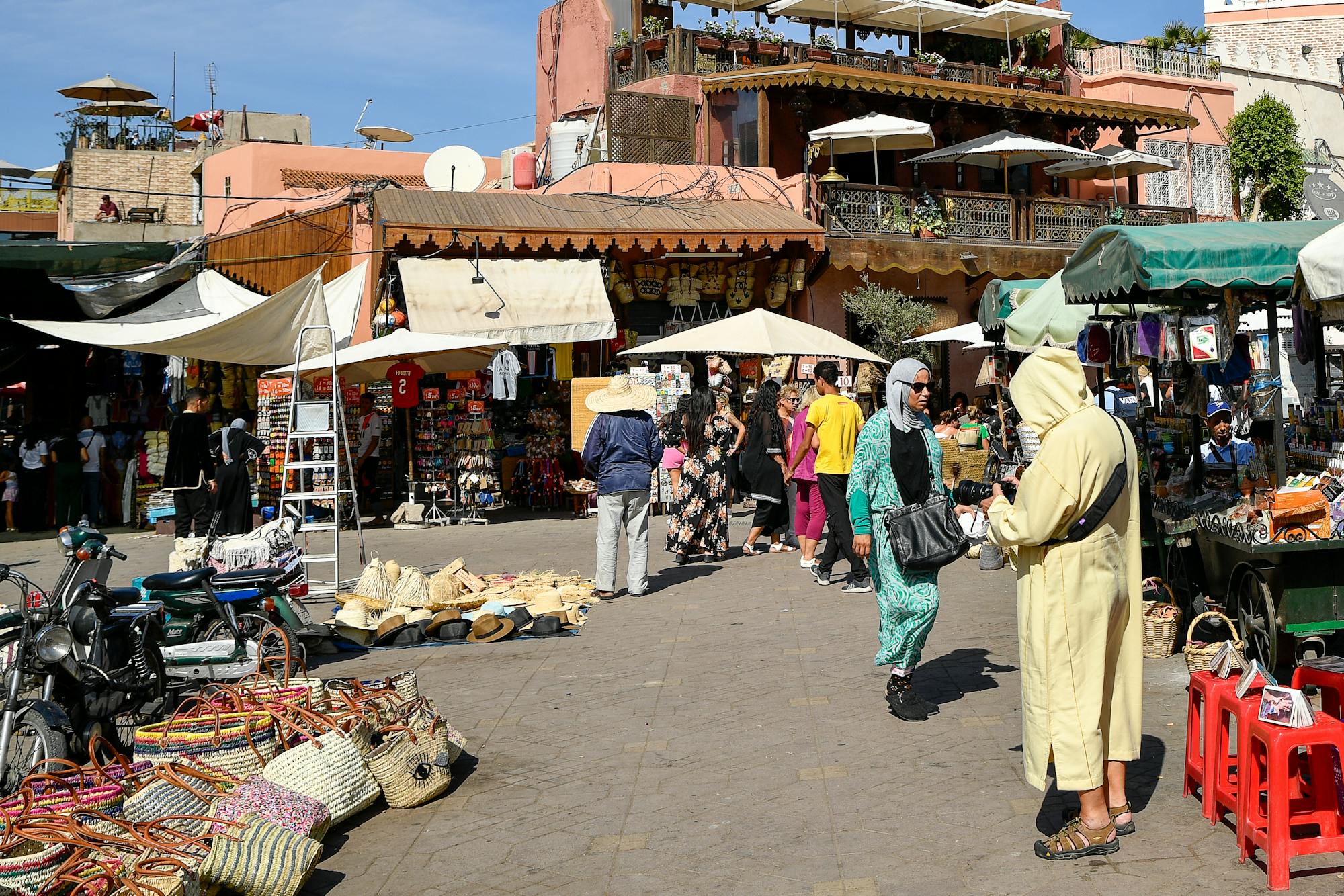
Marrakech — the Red City — is Morocco's most intoxicating destination. Its medieval medina, a UNESCO World Heritage Site, is a 900-year-old labyrinth of souks, madrasas, palaces, and hammams built in rose-pink pisé (rammed earth).
Marrakech — the Red City — is Morocco's most intoxicating destination. Its medieval medina, a UNESCO World Heritage Site, is a 900-year-old labyrinth of souks, madrasas, palaces, and hammams built in rose-pink pisé (rammed earth).
Djemaa el-Fna: The Heartbeat of Marrakech
The Djemaa el-Fna square is one of the world's great public spaces — a UNESCO Masterpiece of the Oral and Intangible Heritage of Humanity, and the living centre of Marrakech life. By day it fills with orange juice sellers, henna artists, snake charmers, and acrobats. By evening it transforms into one of the world's most extraordinary spectacles: hundreds of food stalls appearing from nowhere, musicians, storytellers, and comedians performing for crowds, and the scent of charcoal grilling drifting across the square. No visit to Marrakech is complete without several evenings here — it is endlessly fascinating and does not diminish with repetition.
The Souks
North of Djemaa el-Fna lies one of the world's great market complexes — a vast, interconnected web of specialist souks stretching through the medina. The souk des teinturiers (dyers), the souk des forgerons (blacksmiths), the souk des babouchiers (slipper makers), the carpet souks, the spice market — each trade occupies its own quarter, as it has for centuries. The leather tanneries at the Chouara (Marrakech's version, more accessible than Fes) show the ancient craft of leather processing in vivid colour. Budget an entire morning for souk exploration, engage with the merchants, and be prepared for vigorous negotiation.
Palaces and Gardens
The Bahia Palace (19th century) offers a magnificent insight into what a wealthy Moroccan palace looked like — vast reception rooms with painted cedarwood ceilings, tiled courtyards, and harem gardens. The ruined El Badi Palace gives a sense of the extraordinary scale of Saadian ambition. The Saadian Tombs, discovered behind a sealed wall in 1917, contain the lavishly decorated mausoleums of the 16th-century sultans. The Majorelle Garden — the cobalt-blue paradise created by French painter Jacques Majorelle and later owned by Yves Saint Laurent — is the city's most visited garden, a tranquil escape from the medina's intensity.
The Medina Monuments
The Ben Youssef Madrasa, the largest medieval Islamic college in North Africa, is a masterpiece of Moroccan craftsmanship — every surface covered in zellij tilework, carved plasterwork, and cedarwood inscription. The Koutoubia Mosque, whose minaret (70 metres) has been the model for the Giralda in Seville and the Hassan Tower in Rabat, dominates the Marrakech skyline. The Museum of Marrakech (in the 19th-century Mnebhi Palace) and the Dar Si Said Museum of Moroccan arts are both worth visiting.
Day Trips from Marrakech
Marrakech's position at the foot of the High Atlas makes it an ideal base for mountain excursions. The Ourika Valley (30km) offers waterfalls, Berber villages, and a saffron cooperative. The Aït Benhaddou ksar (UNESCO World Heritage Site, 200km via the Tizi n'Tichka pass) is the most dramatic fortified village in Morocco — the location for Lawrence of Arabia, Gladiator, and Game of Thrones. A camel trek and desert camp from Marrakech via the Dadès Valley (4–5 days) is Morocco's classic journey.