Sicily is the Mediterranean's largest island and one of its most extraordinary destinations — a place where Greek temples stand intact on clifftops above the sea, where Europe's largest active volcano looms over baroque cities, and where a food culture forged by 2,500 years of conquests has created something unlike anything else in Italy.
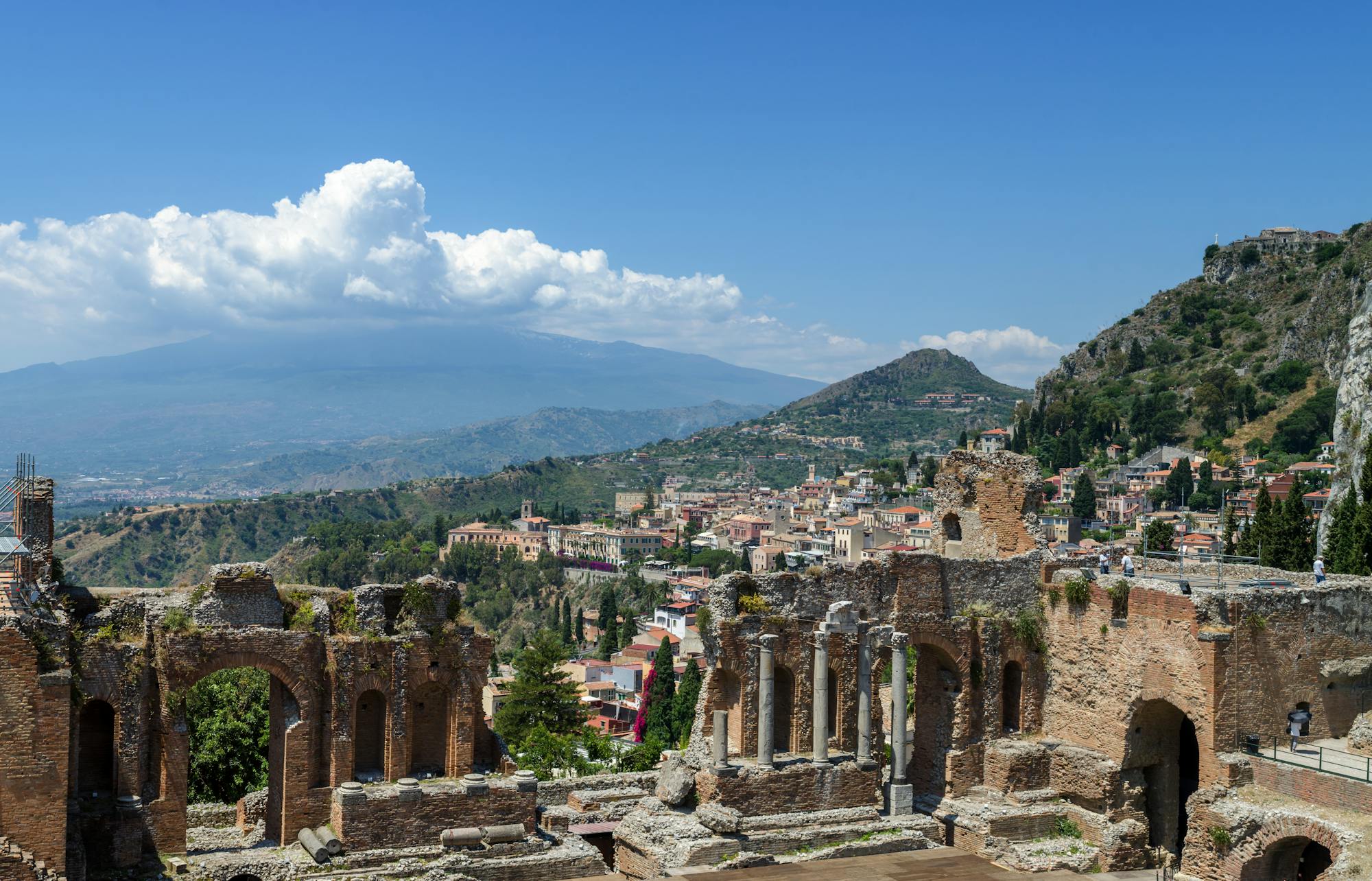
Sicily is the Mediterranean's largest island and one of its most extraordinary destinations — a place where Greek temples stand intact on clifftops above the sea, where Europe's largest active volcano looms over baroque cities, where the Arab-Norman architectural tradition produced some of the world's most beautiful churches, and where a food culture forged by 2,500 years of conquests — Greek, Roman, Arab, Norman, Spanish — has created something unlike anything else in Italy. Sicily is warmer, wilder, more ancient, and more intense than the mainland; it rewards travellers who come with curiosity and time, and delivers experiences — a sunset from Taormina's Greek theatre with Etna smoking behind it, a bowl of pasta con le sarde in a Palermo trattoria, a swim in the waters off the Aeolian Islands — that stay with you for life.
Must-See Attractions
The Greek Theatre of Taormina is Sicily's most iconic image — a 3rd-century BC theatre dramatically positioned on a clifftop with Mount Etna as its backdrop and the Ionian Sea below. Still used for performances, it is one of the most spectacular ancient theatres in the world. The Valley of the Temples (Valle dei Templi) near Agrigento is a UNESCO World Heritage Site of staggering scale — seven Doric temples from the 5th century BC stand in remarkable preservation along a ridge above the south coast, the Temple of Concordia among the best-preserved ancient Greek temples anywhere on Earth. Mount Etna, at 3,357m Europe's highest and most active volcano, can be hiked on the lower slopes (cable car + 4WD jeep) or with guided summit excursions that ascend to the crater rim — an awe-inspiring and somewhat unsettling experience. Palermo, Sicily's exuberant capital, contains the extraordinary Palatine Chapel (Cappella Palatina) — a Norman-era masterpiece whose interior is entirely covered in Byzantine gold mosaics, one of the most ravishing rooms in the world — as well as the Cathedral, the Palazzo dei Normanni, and the extraordinary Ballarò and Vucciria markets. Syracuse (Siracusa), once the most powerful city in the Greek world and rival to Athens, retains an ancient theatre, the ear of Dionysius cave, and the island of Ortigia — a jewel of baroque architecture surrounded by the sea on three sides.
Cultural Experiences
Palermo's street food culture is one of the most vibrant in Italy. The Ballarò market in the Albergheria quarter is the city's oldest and most atmospheric — a labyrinth of stalls selling swordfish, sea urchins, octopus, and every vegetable that grows in Sicilian soil, presided over by vendors whose cries (the abbanniate) are a recognised UNESCO intangible heritage. Street food staples include arancini (fried rice balls stuffed with ragù, cheese, or pistachio), panelle (chickpea fritters), stigghiola (grilled lamb intestines — an acquired taste but utterly authentic), and sfincione (thick Sicilian pizza with tomato, onion, and caciocavallo cheese). The Arab-Norman churches of Palermo — the Martorana, San Cataldo, and the cathedral at Monreale (a 30-minute bus ride from the city, its cloister and apse mosaics breathtaking) — represent one of the world's great medieval artistic traditions, born from the multicultural Norman kingdom of the 12th century. The Catacombe dei Cappuccini in Palermo, where 8,000 mummified bodies line the corridors in their original clothing, is macabre, haunting, and unforgettable.
Day Trips and Excursions
The Aeolian Islands (Isole Eolie) — a UNESCO-listed volcanic archipelago off Sicily's northeast coast — are reachable by hydrofoil from Milazzo (1.5 hours from Messina). Each of the seven islands has a distinct character: Stromboli is a permanently active volcano whose nightly eruptions can be watched from boats offshore or hiked to the crater rim with a guide; Lipari is the largest, with excellent beaches and the Museo Eoliano's extraordinary prehistoric collection; Panarea is the glamorous, car-free retreat favoured by Italian celebrities. From Palermo, the baroque towns of the Val di Noto — Noto, Ragusa Ibla, Modica — form a UNESCO-listed ensemble of earthquake-rebuilt baroque architecture of extraordinary purity and are easily combined in a driving day trip through the island's southeast. Erice, a perfectly preserved medieval hilltown above Trapani with views to Tunisia on clear days, makes a beautiful half-day excursion.
Local Food and Drink Scene
Sicilian cuisine is the most complex and historically layered in Italy — Arab, Greek, Norman, and Spanish influences combine in a food culture that uses ingredients (saffron, cinnamon, pine nuts, raisins, capers from Pantelleria) rarely found in northern Italian cooking. Pasta con le sarde (pasta with sardines, wild fennel, pine nuts, and raisins), caponata (sweet-sour aubergine and caper relish), sarde a beccafico (stuffed sardines with breadcrumbs and pine nuts), and pane cunzato (Sicilian flatbread with toppings) are essential dishes. Granita — a semi-frozen dessert served with brioche for breakfast — is Sicily's most beloved culinary tradition; almond, coffee, and pistachio flavours are the classics. Cannoli (crisp pastry tubes filled with sweetened ricotta and chocolate chips) are an island institution. Sicilian wine has undergone a revolution: Nero d'Avola (rich red), Etna Rosso and Bianco (volcanic wines from the Etna slopes), and the fortified Marsala are the most distinguished. Pistachio from Bronte (on Etna's slopes) — the world's finest — is used in everything from pasta to gelato.
Tips for Getting Around
Sicily requires a rental car to explore properly — the island is large (25,000 km²) and public transport between towns, while it exists, is infrequent and slow. The main cities of Palermo, Catania, Taormina, Syracuse, and Agrigento are connected by train and bus, but the baroque towns of the southeast, Etna's slopes, and the western coast are best reached by car. Driving in Sicily is an adventure — follow local customs, expect motorbikes to appear from unexpected directions, and park only in designated areas (ZTL zones are heavily enforced). Palermo's city bus network (AMAT) is adequate for getting around the capital; the tram network is expanding. Ferries to the Aeolian Islands depart from Milazzo (near Messina); the Tremiti Islands from Termoli. Domestic flights connect Palermo (PMO) and Catania (CTA) to mainland Italy. The Frecciargento high-speed train connects Palermo to Naples and Rome via Messina (ferry crossing included in ticket).