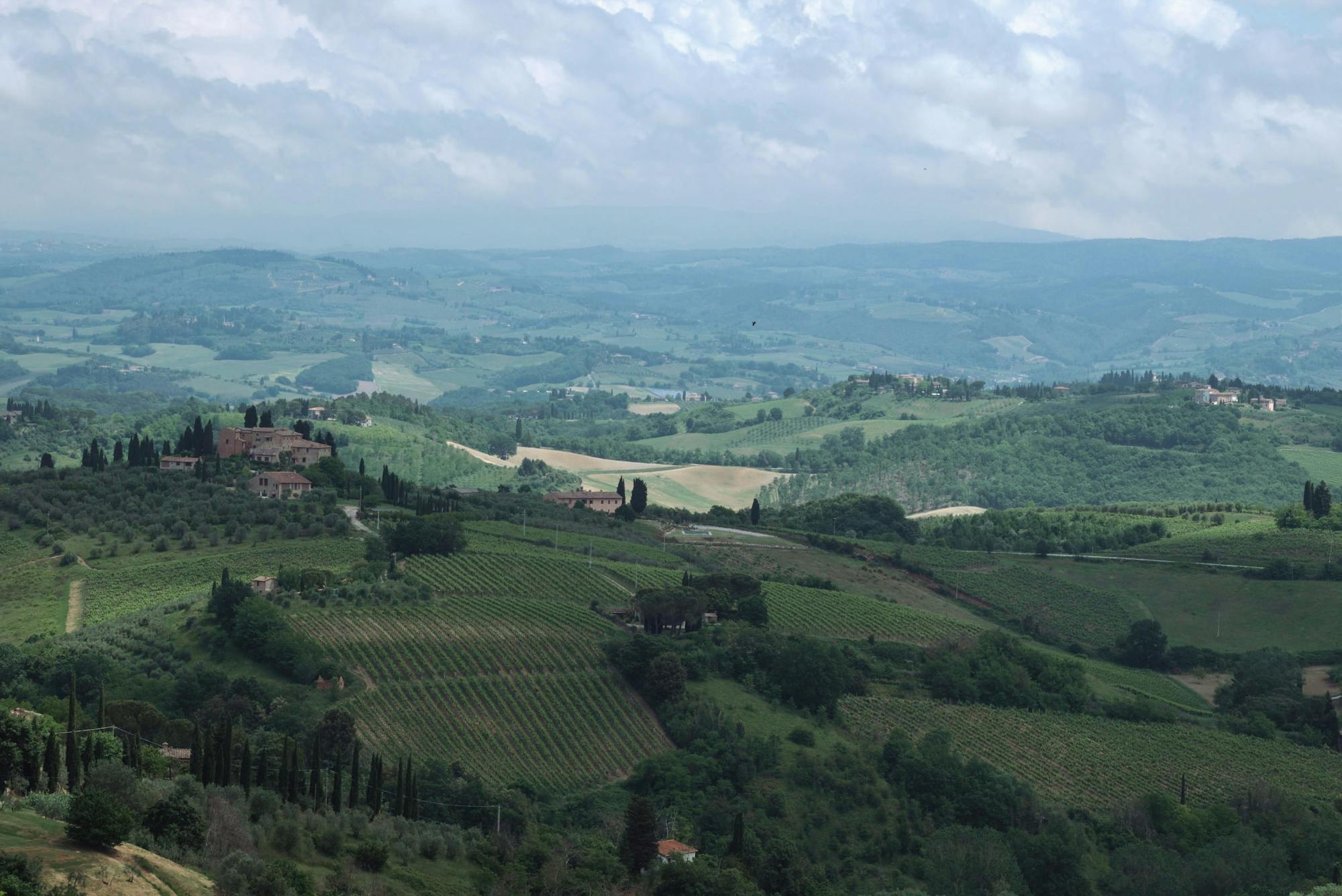
Tuscany is the Italy of the imagination — a region of sublime art cities, rolling hills striped with vines and cypresses, medieval hilltowns perched on volcanic tuff, and a food and wine culture of extraordinary depth and sophistication. It rewards the unhurried traveller — those who linger over a glass of Brunello di Montalcino watching the sun set on terracotta hills find it one of the most deeply satisfying destinations on Earth.
Tuscany is the Italy of the imagination — a region of sublime art cities, rolling hills striped with vines and cypresses, medieval hilltowns perched on volcanic tuff, and a food and wine culture of extraordinary depth and sophistication. It rewards the unhurried traveller — those who linger over a glass of Brunello di Montalcino watching the sun set on terracotta hills find it one of the most deeply satisfying destinations on Earth.
Must-See Attractions
Florence's Uffizi Gallery contains the world's greatest collection of Italian Renaissance painting — Botticelli's Birth of Venus and Primavera, Leonardo's Annunciation, Raphael's Leo X, Titian's Venus of Urbino — and should be booked weeks in advance. The Accademia holds Michelangelo's David, which must be seen in person to comprehend its scale. Siena's Piazza del Campo is arguably Italy's finest medieval square — shell-shaped, softly sloping, lined with 13th-century palazzi, and still the site of the Palio horse race twice yearly (July 2 and August 16). Siena's Duomo — striped black and white marble, with one of the most elaborately decorated interiors in Italy — rivals Florence's cathedral for sheer visual impact. The hill town of San Gimignano, with its 14 surviving medieval towers (once there were 72), is a UNESCO World Heritage Site and one of the most dramatic skylines in Tuscany, though it crowds heavily in summer. Pisa's Campo dei Miracoli — the Leaning Tower, Baptistery, and Duomo together on a lawn of perfect green — is more beautiful and more strange in person than any image suggests.
Cultural Experiences
Florence is one of the world's supreme art cities and rewards slow, deliberate exploration. Beyond the Uffizi and Accademia, essential experiences include Brunelleschi's Dome (climb it for unparalleled views of the city and the surrounding countryside), the Bargello Museum (the greatest collection of Renaissance sculpture after the Uffizi's paintings), San Marco Monastery (Fra Angelico's cell frescoes, painted for the monks' private meditation), and the Brancacci Chapel in Santa Maria del Carmine (Masaccio's revolutionary frescoes that taught the Renaissance how to paint). The Oltrarno neighbourhood on the south bank — centred on the Pitti Palace, Boboli Gardens, and the artisan workshops of Borgo San Jacopo — offers a quieter, more residential Florence that feels genuinely Florentine. In Siena, the Museo dell'Opera del Duomo houses Duccio's Maestà altarpiece and Pisano's original façade statues; the Pinacoteca Nazionale covers the Sienese school from the 13th to 16th centuries with extraordinary depth.
Day Trips and Natural Highlights
The Chianti wine road between Florence and Siena — the SS222, Chiantigiana — passes through some of Tuscany's most classically beautiful landscape: vine-striped hillsides, cypress avenues, stone farmhouses, and medieval villages including Greve in Chianti, Panzano, and Castellina in Chianti. The Val d'Orcia — a UNESCO World Heritage Cultural Landscape south of Siena, centred on Pienza, Montalcino, and Montepulciano — is Tuscany at its most cinematically beautiful: rolling clay hills punctuated by lone cypress trees, the exactly-imagined Renaissance ideal. Lucca — a walled city in the flat plain west of Florence, whose intact Renaissance walls are now a tree-lined promenade — is among the most civilised small cities in Italy, largely bypassed by mass tourism. The Maremma coast (Grosseto province) offers Tuscany's wildest beaches and the ruins of Etruscan cities like Populonia and Vetulonia — largely unknown to non-Italian tourists.
Food and Wine
Tuscan cuisine is the foundation of what most of the world understands as Italian food — simple, ingredient-led, deeply satisfying. Bistecca alla Fiorentina — a T-bone of Chianina beef, aged and cooked over wood to rare, served with olive oil and nothing else — is the region's signature dish and must be eaten at a Florentine trattoria with a carafe of Chianti Classico. Ribollita (bread and vegetable soup, rebaked), pappa al pomodoro (tomato and bread soup), pappardelle al cinghiale (pasta with wild boar ragù), and lampredotto (tripe sandwich from Florentine street stalls) are essential. Tuscany's wine landscape is one of the world's most distinguished: Brunello di Montalcino (Italy's most cellar-worthy red), Chianti Classico (the heartland Sangiovese), Vino Nobile di Montepulciano, Vernaccia di San Gimignano (Italy's first DOC white wine), and the Super Tuscans of Bolgheri (Sassicaia, Ornellaia) define the canon. Visiting wine estates in the Chianti, Montalcino, or Montepulciano zones — many of which accept visitors for tastings — is one of Tuscany's great pleasures.
Getting Around
A rental car is strongly recommended for exploring Tuscany beyond Florence and Siena — the hill towns, wine roads, and coastal Maremma are not practically reached by public transport. Driving the Chiantigiana (SS222) or the Val d'Orcia roads is itself a pleasure. Florence's historic centre is a Limited Traffic Zone (ZTL) — do not drive into it with a rental car; park at the Piazzale Michelangelo or Fortezza da Basso and walk. Florence and Siena are connected by the Sena Express bus (1.5 hours, very frequent, very cheap) and by the Rapida bus service via the autostrada (1 hour 15 min). Trenitalia connects Florence to Pisa (1 hour), Lucca (1.5 hours), and Arezzo (1 hour). The Frecciarossa high-speed train links Florence to Rome (1.5 hours) and Milan (1.75 hours) — an easy day trip in either direction. Within Florence, walking is the best way to move between sights; the city centre is compact enough that nearly everything is within 20 minutes on foot.