Valencia is Spain's third-largest city and one of its most rewarding — a place where futuristic architecture by Santiago Calatrava coexists with a medieval old town of exceptional beauty, where paella was invented (and still made properly), where the world's greatest fire festival burns every March, and where a laid-back Mediterranean temperament makes visitors feel immediately at home.
Valencia is Spain's third-largest city and one of its most rewarding — a place where futuristic architecture by Santiago Calatrava coexists with a medieval old town of exceptional beauty, where paella was invented (and still made properly), where the world's greatest fire festival burns every March, and where a laid-back Mediterranean temperament makes visitors feel immediately at home. Less frenetic than Madrid or Barcelona, Valencia offers a genuine, modern Spanish city experience at a more human pace — with better beaches than either.
Top Attractions in Valencia
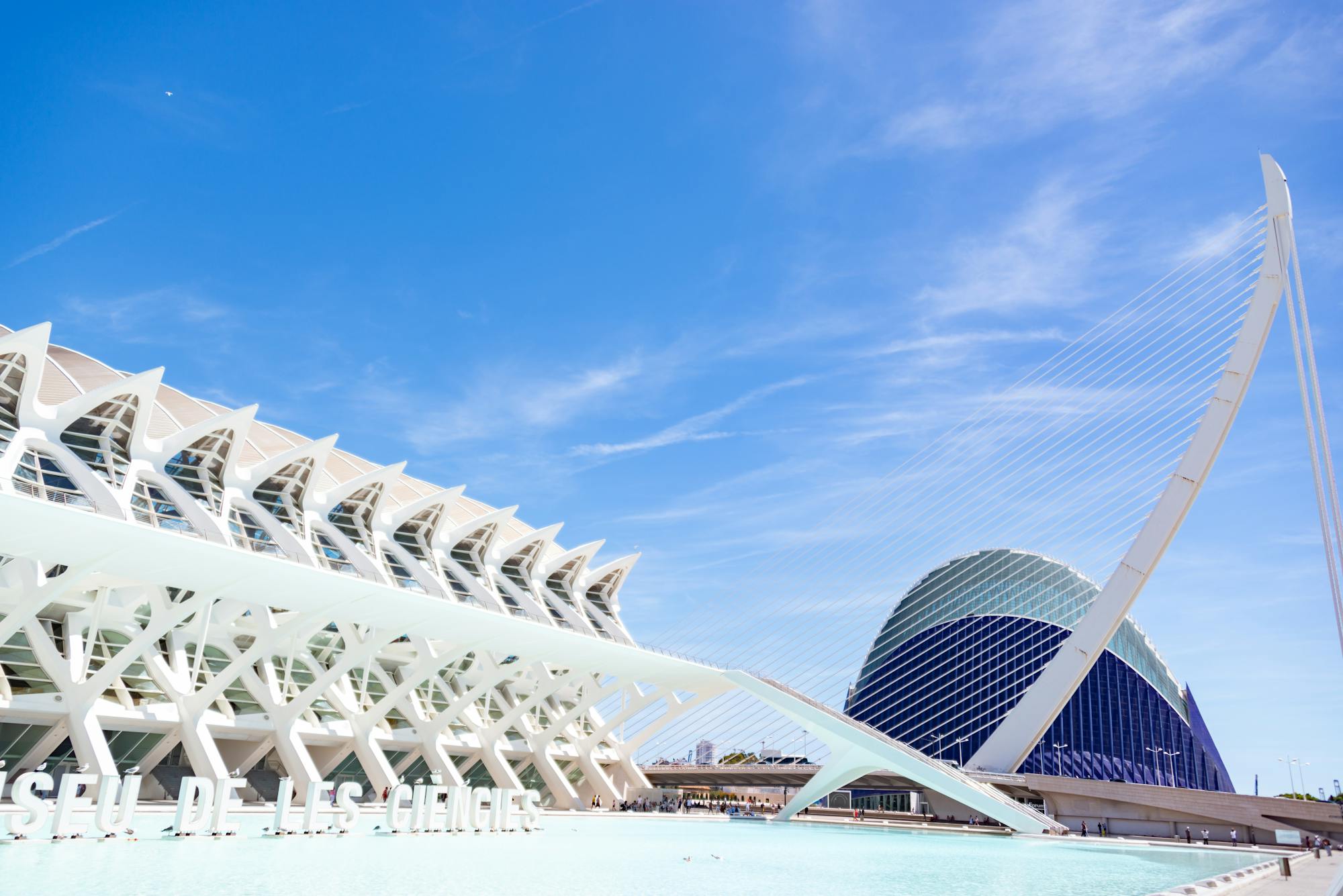
The Ciudad de las Artes y las Ciencias (City of Arts and Sciences) is Valencia's most iconic modern landmark — a futuristic complex designed by Santiago Calatrava and Félix Candela that includes the Hemisfèric (an IMAX cinema shaped like an eye), the Museu de les Ciències Príncep Felip (interactive science museum), the Palau de les Arts Reina Sofía (opera house), and the L'Oceanogràfic (Europe's largest aquarium). The entire complex, built in the former Turia riverbed, is spectacular at any time of day but magical at dusk when the white structures reflect in the shallow water channels. The Barrio del Carmen, Valencia's medieval neighbourhood, is a labyrinth of narrow streets with Moorish gates, Roman foundations, and excellent bars and restaurants — the city's creative and social hub. The Valencia Cathedral (Catedral de Santa María) in the old town houses what is claimed to be the Holy Grail — an ancient agate chalice in the Capilla del Santo Cáliz — and the Miguelete bell tower can be climbed for sweeping views across the city. The Mercado Central (Central Market), a magnificent Modernista iron-and-tile building from 1928, is one of Europe's largest covered food markets and one of its most beautiful — an essential Valencia experience.
Unique Local Experiences
The Las Fallas festival (March 15–19) is Valencia's most spectacular annual event and one of the world's most extraordinary celebrations: over a week, the city fills with enormous (and often satirical) papier-mâché sculptures called fallas, accompanied by daily fireworks displays of astonishing intensity, floral offerings to the Virgin, and street parties that continue until dawn. On the final night, all the fallas except the winners are ceremonially burned in a citywide bonfire — a cathartic, astonishing spectacle. Valencia is also the birthplace of paella, and eating an authentic Valencian paella is a serious cultural experience — made with rabbit, chicken, ferraura green beans, and garrofó white beans in a wood-fired pan. Head to the Albufera wetlands area south of the city for the most authentic versions. The Turia Garden (Jardí del Túria), a 9-kilometre linear park built in the drained former river bed, is one of Europe's finest urban parks — cycle or walk its entire length for a stunning cross-section of Valencia's neighbourhoods and architecture.
Day Trips from Valencia
La Albufera Natural Park, just 15 km south, is a freshwater lagoon surrounded by rice paddies — the landscape that gave birth to paella. Boat trips on the lagoon at sunset are beautiful, and the waterside restaurants of El Palmar serve excellent authentic paella. Peñíscola (2 hours north by train or car) is a dramatic medieval castle-town perched on a rocky peninsula jutting into the sea — one of Spain's most photographed cityscapes and a memorable half-day coastal excursion.
Practical Tips for Visitors
Valencia has an excellent metro and tram network; the EMT bus system covers the entire city. The old town, Barrio del Carmen, and Mercado Central are all walkable. Cycle hire is popular and the Turia Garden cycle path connects all the main sights. Valencia's beaches (Malvarrosa and Las Arenas) are a short tram ride from the city centre. Must-try foods: Valencian paella (the real thing has no seafood), horchata (a sweet tiger nut milk drink, served ice-cold at a horchatería), agua de Valencia (cava, orange juice, and gin), and all'i pebre (a garlic-and-paprika eel stew from the Albufera). Las Fallas in March requires booking accommodation at least six months ahead — prices triple during the festival week.