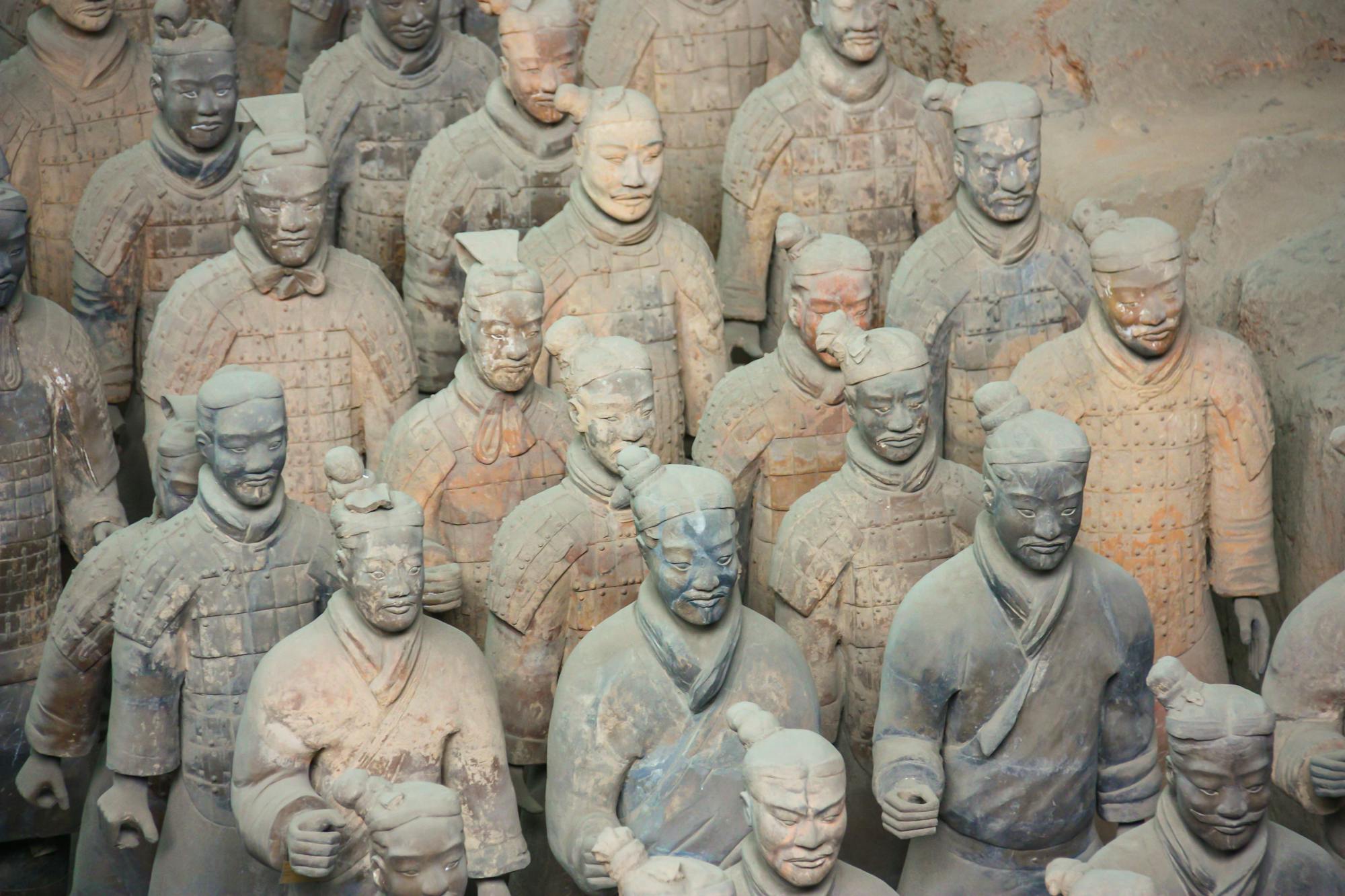
Xi'an is one of the great ancient capitals of the world — a city that served as the eastern terminus of the Silk Road and the imperial seat of eleven Chinese dynasties, including the Qin, Han, and Tang. The city's most famous legacy — the Terracotta Army of Emperor Qin Shi Huang — is one of the greatest archaeological discoveries of the 20th century, but Xi'an offers far more than its headline attraction: intact Ming Dynasty city walls, the atmospheric Muslim Quarter with its Great Mosque, the Tang Dynasty Big Wild Goose Pagoda, and some of China's most distinctive street food.
Xi'an is one of the great ancient capitals of the world — a city that served as the eastern terminus of the Silk Road and the imperial seat of eleven Chinese dynasties, including the Qin, Han, and Tang. The city's most famous legacy — the Terracotta Army of Emperor Qin Shi Huang — is one of the greatest archaeological discoveries of the 20th century, but Xi'an offers far more than its headline attraction: intact Ming Dynasty city walls, the atmospheric Muslim Quarter with its Great Mosque, the Tang Dynasty Big Wild Goose Pagoda, and some of China's most distinctive street food.
Top Attractions
The Terracotta Army, located 30km east of Xi'an, is one of the most extraordinary archaeological sites on earth — over 8,000 life-sized warriors, horses, and chariots buried to guard Emperor Qin Shi Huang in the afterlife, each with individualised facial features, discovered by farmers in 1974 after lying undisturbed for 2,200 years. Pit 1 is the main hall, but Pit 2 contains the most tactically sophisticated arrangement of cavalry and infantry. Arrive when the site opens at 8:30am to beat tour groups. The Xi'an City Walls, the most complete ancient city walls in China, form a 14km circuit of Ming Dynasty fortification that can be walked or cycled at the top — renting a bicycle and cycling the full circuit takes about 1.5 hours and offers elevated views over the old city and its modern surroundings. The Muslim Quarter (Huimin Jie) is Xi'an's most atmospheric neighbourhood — a dense network of narrow lanes around the Great Mosque where the city's Hui Muslim community has lived since the Tang Dynasty, the streets lined with stalls selling pomegranate juice, lamb skewers, persimmon cakes, and biang biang noodles. The Great Mosque of Xi'an, hidden behind the Muslim Quarter's main street, is one of China's most beautiful mosques — built in Chinese architectural style rather than Middle Eastern, its pavilions and courtyards date to the Tang Dynasty, though the current structures are mostly Ming-era.
Cultural Immersion
Xi'an's Shaanxi History Museum, one of China's finest provincial museums, houses over 370,000 artefacts spanning 1.5 million years of human settlement in the Wei River Valley — its Tang Dynasty gold and silver collection and the displays of Han Dynasty artefacts are outstanding. Admission is free but requires advance online booking; the special exhibition gallery requires a separate ticket. The Tang Dynasty Show at the Shaanxi Grand Opera House is a theatrical performance of Tang court music and dance in elaborate costume — touristy but genuinely spectacular, and a useful window into the cultural golden age when Xi'an (then Chang'an) was the world's largest and most cosmopolitan city. For a more authentic cultural experience, the Drum Tower and Bell Tower in the city centre — twin Ming-era towers that once marked the city's timekeeping — host regular drumming and bell-ringing performances that draw as many locals as tourists.
Day Trips
The Huashan Mountain (Mount Hua), one of China's Five Sacred Mountains, lies 120km east of Xi'an and makes an extraordinary day trip for those prepared for a serious hike — its five peaks, connected by narrow stone-cut paths and chain-assisted cliff faces, offer some of China's most dramatic mountain scenery. The most challenging route is the famous North Peak trail, which includes the terrifying Plank Road (a series of narrow planks bolted into a vertical cliff face — not for the faint-hearted). The Famen Temple, 120km west of Xi'an, houses authentic Buddhist relics of the Tang Dynasty including a finger bone of the historical Buddha — a major pilgrimage site that gained new relevance when its underground crypt, sealed for 1,100 years, was opened in 1987. The Qianling Mausoleum, the joint burial site of Tang Emperor Gaozong and Empress Wu Zetian (China's only female emperor), lies 80km northwest of Xi'an in a landscape of carved stone guardian figures leading to an unexcavated imperial tomb.
Food Culture
Xi'an's street food is among China's most distinctive, shaped by the city's Silk Road history and its large Hui Muslim community. Biang biang noodles — thick, hand-pulled noodles wider than a belt, served with chilli oil, garlic, and vinegar — are Xi'an's signature dish, named for the sound the dough makes when slapped against the counter. Roujiamo (Chinese hamburger) is a flatbread filled with slow-braised spiced pork or cumin-scented lamb — the Muslim Quarter version with lamb is exceptional. Yang rou pao mo is Xi'an's most famous comfort food — a thick lamb soup in which diners tear their own flatbread into small pieces before the broth is poured over, a ritual that separates tourists from locals based on bread-tearing technique. The Muslim Quarter is the primary street food destination: wander from stall to stall sampling pomegranate juice (fresh pressed in season), persimmon cakes, sesame flatbreads, and lamb skewers. Avoid the tourist-oriented restaurants on the main street in favour of the side alleys where locals eat.
Practical Tips
Xi'an is easily reached by high-speed rail from Beijing (4.5 hours on G-trains), Shanghai (6-7 hours), and Chengdu (3.5 hours). The city has a small but useful metro system connecting the train station, city walls, and major sights. The Xi'an North Railway Station (for high-speed trains) is 15km from the city centre — metro Line 4 connects it to the Bell Tower in about 25 minutes. For the Terracotta Army, take the Metro Line 9 to the Huaqing Pool stop, then Bus 306 (about 30 minutes) — this avoids the inflated taxi fares at the main station. A VPN is essential for accessing Google Maps, WhatsApp, and most Western social media — download and test before arriving in China. The best time to visit Xi'an is spring (April–May) and autumn (September–October), avoiding the extreme summer heat (40°C+) and the cold, sometimes snowy winters. The city's major crowds peak during Chinese National Holidays (Golden Week in October) — book accommodation and Terracotta Army tickets well in advance.