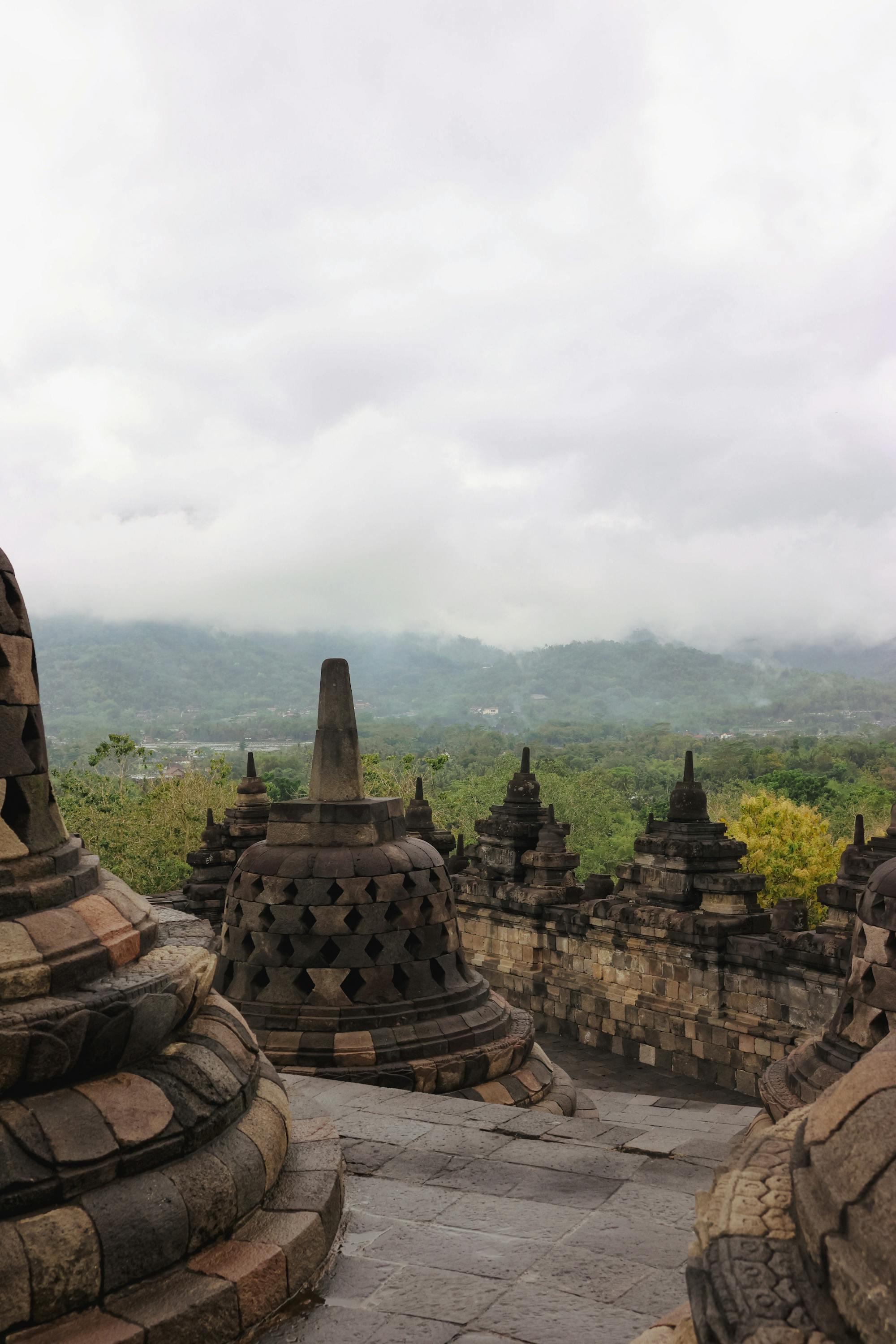
Yogyakarta — affectionately known as Jogja — is the cultural soul of Java and one of Indonesia's most rewarding cities, where two of the world's greatest ancient monuments sit within an hour's drive of each other, the 18th-century Sultanate still holds court in a living royal palace, and the volcanic cone of Mount Merapi broods on the northern horizon. It rewards intellectual curiosity and cultural appetite in equal measure.
Yogyakarta — affectionately known as Jogja — is the cultural soul of Java and one of Indonesia's most rewarding cities. This is a place where two of the world's greatest ancient monuments sit within an hour's drive of each other, where the 18th-century Sultanate still holds court in a living royal palace, where artisans produce batik cloth and wayang shadow puppets using techniques unchanged for centuries, and where the volcanic cone of Mount Merapi broods on the northern horizon. Unlike Bali's beach-and-villa tourism, Yogyakarta rewards intellectual curiosity and cultural appetite: visitors come to stand in awe before the Buddhist stupa of Borobudur at sunrise, to navigate the carved stone reliefs of Prambanan, and to learn the deep philosophical traditions embedded in Javanese art and performance. It is also a university city — home to dozens of institutions — which gives it a youthful, affordable, and intellectually engaged energy unlike anywhere else in Indonesia.
Top Attractions
Borobudur, 40km northwest of Yogyakarta, is the world's largest Buddhist temple and one of the greatest monuments of human civilisation. Built in the 9th century by the Sailendra dynasty and abandoned for centuries before being rediscovered under volcanic ash, its nine stacked platforms are decorated with 2,672 relief panels and 504 Buddha statues. Arriving at dawn — the 4:30am minibus from Yogyakarta is worth every sleepy moment — to watch the sun rise through the mist over the volcanic landscape surrounding the temple is a genuinely transcendent experience. Prambanan, 17km east of Yogyakarta, is the counterpoint: a towering complex of Hindu temples built just decades after Borobudur, dedicated to the Trimurti of Brahma, Vishnu, and Shiva. The central Shiva temple rises 47 metres and its carved reliefs of the Ramayana epic are considered masterpieces of Asian art; the Sendratari Ramayana Ballet performed against the illuminated temple backdrop on full moon evenings is one of Indonesia's most spectacular performances. Keraton Yogyakarta (the Sultan's Palace), still the active home of the Sultan, is a complex of pavilions, ceremonial halls, and royal museums where traditional Javanese court gamelan music is performed live most mornings.
Cultural Immersion
Yogyakarta is Indonesia's centre of batik production — the ancient wax-resist dyeing technique applied to cotton and silk to create intricate geometric and floral patterns. The Batik Research Centre and the workshops along Jalan Tirtodipuran offer demonstrations and classes where visitors can create their own batik cloth using traditional copper stamps (cap) or hand-drawn wax (tulis) techniques. Wayang kulit (shadow puppet theatre) is another Yogyakarta art form of profound antiquity: leather puppets, some over 500 years old, are manipulated by a dalang (puppet master) who voices all characters while conducting a gamelan orchestra through an all-night performance drawn from the Mahabharata or Ramayana epics. Shorter tourist performances at the Sonobudoyo Museum run from 8pm. The Jalan Malioboro pedestrian strip is Yogyakarta's social and commercial spine — lined with becak (cycle rickshaws), batik shops, street food vendors, and silver jewellery stalls — best explored in the evening when the city promenades. Visit the Affandi Museum, the studio-home of Indonesia's most celebrated Expressionist painter, whose giant murals and gestural oil paintings fill a riverside compound south of the city.
Day Trips
The Borobudur sunrise tour is the most essential day trip — most guesthouses organise minibus departures at 4:30am to reach the temple before the official opening, allowing access to the upper platforms as the sun crests the Menoreh Hills. Combining Borobudur and the nearby Pawon and Mendut temples in a single day makes efficient use of the trip west. In the other direction, a day combining Prambanan with the smaller but exquisite Plaosan and Sewu temples (rarely crowded, just minutes away) reveals the full scale of the 9th-century temple-building programme. Mount Merapi, Java's most active volcano and one of the world's most dangerous, can be visited on a jeep tour (departing from Kaliurang village) that weaves through the 2010 eruption's lava fields and visits the ruins of the village destroyed that year. A dawn trek to the rim of Merapi is possible for experienced hikers with a guide; the views from the upper slopes over Java at sunrise are extraordinary.
Food Culture
Yogyakarta's food scene is centred on gudeg — young jackfruit slow-cooked in coconut milk and palm sugar until it becomes rich, dark, and deeply savoury, typically served with rice, krecek (spiced buffalo skin cracklings), egg, and chicken. Gudeg Yu Djum on Jalan Wijilan (the city's gudeg street) has been open since 1950 and remains one of the most beloved restaurants in Indonesia. Sate klathak — goat satay grilled over charcoal on iron spoke skewers rather than bamboo, giving a distinctive metallic char — is another Yogyakarta speciality, best at Sate Klathak Pak Pong in Bantul. The angkringan (small roadside food carts with benches) that line the streets at night serve nasi kucing (tiny portions of rice with sambal and anchovies), various sate, and sweet ginger tea — an essential, cheap, and deeply local experience. For dessert, jadah tempe — glutinous rice cakes served with fermented soybean tempeh from Kaliurang — is a local pairing that sounds peculiar and tastes wonderful.
Practical Tips
Yogyakarta is served by Adisutjipto International Airport and the newer Yogyakarta International Airport (YIA) at Kulon Progo. The city centre is compact and manageable by becak, ojek (motorbike taxi), or the Trans Jogja bus network. Grab operates and is the most reliable option for longer journeys. Borobudur and Prambanan require separate entrance tickets (around 350,000 IDR each for foreign visitors); book the Ramayana Ballet performance tickets in advance during peak season. The best months to visit are May–September during the dry season, when temple visits are unimpeded by rain and the volcanic views from Merapi are clearest. Guides at Borobudur dramatically enhance the experience — a good guide can explain the narrative of the 2km-long relief panels that circle the temple's galleries and decode the Buddhist cosmology encoded in the structure's three tiers.